UNITED STATES
SECURITIES AND EXCHANGE COMMISSION
Washington, D.C. 20549
FORM 10-K/A
Amendment No.1
(Mark One)
|
ANNUAL REPORT PURSUANT TO SECTION 13 OR 15(d) OF THE SECURITIES EXCHANGE ACT OF 1934
|
For the fiscal year ended December 31, 2025
or
|
TRANSITION REPORT PURSUANT TO SECTION 13 OR 15(d) OF THE SECURITIES EXCHANGE ACT OF 1934
|
For the transition period from to
Commission File Number 001-39050
(Exact Name of Registrant as Specified in its Charter)
|
|
|
|
|
State or Other Jurisdiction of Incorporation or Organization
|
I.R.S. Employer Identification No.
|
|
|
|
|
|
Address of Principal Executive Offices
|
Zip Code
|
(650 ) 810-8823
Registrant’s Telephone Number, Including Area Code
Securities registered pursuant to Section 12(b) of the Act:
|
Title of each class
|
Trading
Symbol(s)
|
Name of each exchange
on which registered
|
||
|
|
|
|
Indicate by check mark if the registrant is a well-known seasoned issuer, as defined in Rule 405 of the Securities Act. Yes ☐ No ☒
Indicate by check mark if the registrant is not required to file reports pursuant to Section 13 or 15(d) of the Act. Yes ☐ No ☒
Indicate by check mark whether the registrant (1) has filed all reports required to be filed by Section 13 or 15(d) of the Securities Exchange
Act of 1934 during the preceding 12 months (or for such shorter period that the registrant was required to file such reports), and (2) has been subject to such filing requirements for the past 90 days. Yes ☒ No ☐
Indicate by check mark whether the registrant has submitted electronically every Interactive Data File required to be submitted pursuant to
Rule 405 of Regulation S-T (§ 232.405 of this chapter) during the preceding 12 months (or for such shorter period that the registrant was required to submit such files). Yes ☒ No ☐
Indicate by check mark whether the registrant is a large accelerated filer, an accelerated filer, a non-accelerated filer, a smaller reporting
company, or an emerging growth company. See the definitions of “large accelerated filer,” “accelerated filer,” “smaller reporting company,” and “emerging growth company” in Rule 12b-2 of the Exchange Act.
|
Large accelerated filer
|
☐ |
Smaller reporting company
|
|
|
|
☒ |
Emerging growth company
|
|
|
Non-accelerated filer
|
☐ |
If an emerging growth company, indicate by check mark if the registrant has elected not to use the extended transition period for complying
with any new or revised financial accounting standards provided pursuant to Section 13(a) of the Exchange Act. ☐
Indicate by check mark whether the registrant has filed a report on and attestation to its management’s assessment of the effectiveness of its
internal control over financial reporting under Section 404(b) of the Sarbanes-Oxley Act (15 U.S.C. 7262(b)) by the registered public accounting firm that prepared or issued its audit report. ☒
If securities are registered pursuant to Section 12(b) of the Act, indicate by check mark whether the financial statements of the registrant
included in the filing reflect the correction of an error to previously issued financial statements. ☐
Indicate by check mark whether any of those error corrections are restatements that required a recovery analysis of incentive-based
compensation received by any of the registrant’s executive officers during the relevant recovery period pursuant to §240.10D-1(b). ☐
Indicate by check mark whether the registrant is a shell company (as defined in Rule 12b-2 of the Act). Yes ☐ No ☒
The aggregate market value of the common stock held by non-affiliates of the registrant, based on the closing price of a share of common stock
on June 30, 2025 as reported by the Nasdaq Global Select Market on such date was approximately $234.6 million. Shares of the
registrant’s common stock held by each executive officer, director and holder of 5% or more of the outstanding common stock have been excluded in that such persons may be deemed to be affiliates. This calculation does not reflect a
determination that certain persons are affiliates of the registrant for any other purpose.
The number of shares of registrant’s common stock outstanding as of April 23, 2026 was 45,738,543 .
DOCUMENTS INCORPORATED BY REFERENCE
None.
On February 27, 2026, Oportun Financial Corporation filed its Annual Report on Form 10-K for the fiscal year ended December 31, 2025 (the “Original Form 10-K”).
The Original Form 10-K omitted portions of Part III, Items 10 (Directors, Executive Officers and Corporate Governance), 11 (Executive Compensation), 12 (Security Ownership of Certain Beneficial Owners and Management and Related Stockholder Matters), 13 (Certain Relationships and Related Transactions, and Director
Independence), and 14 (Principal Accountant Fees and Services) in reliance on General Instruction G(3) to Form 10-K, which provides that such information may be either incorporated by reference
from the registrant’s definitive proxy statement or included in an amendment to Form 10-K, in either case filed with the Securities and Exchange Commission (“SEC”) not later than 120 days after the end of the fiscal year.
We no longer expect that the definitive proxy statement for our 2026 annual meeting of stockholders will be filed within 120 days of December 31, 2025.
Accordingly, this Amendment No. 1 to Form 10-K (this “Amendment”) is being filed solely to:
|
•
|
amend and restate Part III, Items 10, 11, 12, 13, and 14 of the Original Form 10-K to include the information required by such Items;
|
|
•
|
delete the reference on the cover of the Original Form 10-K to the incorporation by reference of portions of our proxy statement into Part III of the Original Form 10-K; and |
|
•
|
file a new certification of our principal executive officer, principal financial officer and principal accounting officer as an exhibit to this Amendment under Item 15 of Part IV hereof, pursuant to Rule 12b-15 under the Securities Exchange Act of 1934, as amended (“Exchange Act”). No financial statements are included in this Amendment and this Amendment does not contain or amend any disclosure with respect to Items 307 and 308 of Regulation S-K; accordingly, paragraphs 3, 4 and 5 of the certifications have been omitted. |
This Amendment does not otherwise change or update any of the disclosures set forth in the Original Form 10-K, including the financial statements, and does not
otherwise reflect any events occurring after the filing of the Original Form 10-K. Accordingly, this Amendment should be read in conjunction with the Original Form 10-K and the Company’s filings made with the SEC subsequent to the filing of the
Original Form 10-K. Capitalized terms used herein and not otherwise defined are defined as set forth in the Original Form 10-K.
As used in this report, the terms “Oportun Financial Corporation,” “Company,” “Oportun,” “we,” “us,” and “our” mean Oportun Financial Corporation and its
subsidiaries unless the context indicates otherwise.
| 2 |
||
|
PART III
|
||
|
Item 10.
|
4 |
|
|
Item 11.
|
10 |
|
|
Item 12.
|
42 |
|
|
Item 13.
|
44
|
|
|
Item 14.
|
49 |
|
|
PART IV
|
||
|
Item 15.
|
||
| 50 |
||
| 52 |
||
PART III
Board of Directors
The following biographical and certain other information for each of our directors is presented as of April 23, 2026:
Jo Ann Barefoot, age 76, has served as a member of our Board since October 2016, and her current term expires in 2026. Ms. Barefoot is CEO and Founder of the nonprofit organization AIR-the Alliance for Innovative Regulation,
Co-founder of Hummingbird RegTech, CEO of Barefoot Innovation Group and host of the podcast show Barefoot Innovation. Ms. Barefoot was a Senior Fellow at the John F. Kennedy School of Government’s Mossovar-Rahmani Center for Business and
Government at Harvard University from July 2015 to June 2017. She serves on the Milken Institute FinTech Advisory Committee and previously served on the Consumer Advisory Board of the Consumer Financial Protection Bureau. Ms. Barefoot
previously chaired the boards of directors of the Financial Health Network and FinRegLab. She previously served as Deputy Comptroller of the Currency, on the staff of the U.S. Senate Committee on Banking, Housing and Urban Affairs, as
Co-Chair of the consulting firm Treliant Risk Advisors, as a Partner and Managing Director at KPMG Consulting and as Director of Mortgage Finance for the National Association of Realtors. Ms. Barefoot received a B.A. in English from the
University of Michigan. We believe that Ms. Barefoot’s deep understanding of consumer finance and experience in government provide her with a unique perspective that benefits our Board.
Douglas Bland, age 58, has served as our Chief Executive Officer and as a member of our Board since April 2026, and his current term expires in 2028. He previously served on the board of directors of WebBank, a leading
bank-as-a-service institution, from September 2025 to April 2026 and has served on the board of directors of Creditly, Inc., an AI-driven financial wellness fintech, since April 2025. From September 2017 until July 2024, Mr. Bland served in
various positions at PayPal, Inc., most recently as SVP & General Manager, Consumer Business. Mr. Bland also served as the President and Chief Operating Officer of Swift Financial, a venture-backed small business lender, from 2015 until
it was acquired by PayPal in 2017. From 2004 to 2015, Mr. Bland served in various roles at Bank of America, most recently as SVP, Small Business Products and Risk. Mr. Bland received an M.B.A. from the University of Arkansas at Little Rock
and a B.A. from Hendrix College. We believe that Mr. Bland is qualified to serve as a member of our Board because of his experience in our industry and his role as our Chief Executive Officer.
Mohit Daswani, age 51, has served as a member of our Board since February 2024, and his current term expires in 2026. He currently serves as the Chief Financial Officer of SimplePractice, a web-based electronic health record
solution, since August 2024. Prior to joining SimplePractice, Mr. Daswani served as the Chief Financial Officer of ThoughtSpot, Inc., an AI-enabled business analytics company from January 2020 to July 2024. Prior to joining ThoughtSpot, Mr.
Daswani was the Head of Finance & Strategy at Square, Inc. He previously held leadership roles in Corporate Development and Finance at PayPal, Inc. and was a private equity investor in the financial services, healthcare, and IT industries
as a Principal at JMI Equity, a Principal at FTV Capital, and previously as a long-tenured private equity professional at J.P. Morgan. Mr. Daswani has also served as an advisory Board Member of Centana Growth Partners since 2018. Mr. Daswani
holds a Bachelor’s degree in Economics from Columbia University and an M.B.A. from the Harvard Business School. We believe Mr. Daswani is qualified to serve as a member of our Board because of his extensive experience in the financial and
technology sectors, as well as his leadership experience in the areas of investing, finance and accounting.
Ginny Lee, age 59, has served as a member of our Board since September 2021, and her current term expires in 2027. From December 2016 to June 2021, Ms. Lee served as the President and Chief Operating Officer of Khan Academy, one of
the largest and most widely used online learning platforms globally. Prior to Khan Academy, Ms. Lee spent more than 17 years at Intuit where she held multiple senior operational and technical roles, including Senior Vice President and General
Manager of Intuit’s Employee Management Solutions Division, as well as Chief Information Officer. She currently serves as an advisor and director for several private companies. Ms. Lee received dual baccalaureate degrees in Business Economics
and Organizational Behavior and Management from Brown University and a M.B.A. from the Stanford Graduate School of Business. We believe that Ms. Lee’s strong background of business, technology leadership roles and experience bringing products
to market enable her to make valuable contributions to our Board.
Carlos Minetti, age 63, has served as a member of our Board since February 2024, and his current term expires in 2028. He currently serves as CEO of the Merchant Acquiring Limited Purpose Bank at Stripe Inc., a role he has held
since October 2024. Previously, he served as the Executive Vice President, President-Consumer Banking for Discover Financial Services (“Discover”), a role he held from February 2014 to September 2023. Previously, he served as Executive Vice
President, President-Consumer Banking and Operations (2010 to 2014), Executive Vice President, Cardmember Services and Consumer Banking (2007 to 2010) and Executive Vice President for Cardmember Services and Chief Risk Officer (2001 to 2007)
for Discover. Prior to joining Discover, Mr. Minetti worked in card operations and risk management for American Express Company from 1987 to 2000, where he last served as Senior Vice President. Mr. Minetti currently serves as a member of the
board of directors of Trustmark Mutual Holding Company, the Better Business Bureau of Chicago and Northern Illinois, and the Ann & Robert H. Lurie Children’s Hospital of Chicago Foundation. He was a member of the board of directors of
Discover Bank from 2001 to 2023. Mr. Minetti holds a Bachelor’s degree in Industrial Engineering from Texas A&M University and an M.B.A. from the Booth School of Business at The University of Chicago. We believe that Mr. Minetti’s
extensive experience in the consumer finance industry enables him to make valuable contributions to our Board.
Louis P. Miramontes, age 71, has served as a member of our Board since October 2014, and his current term expires in 2027. Mr. Miramontes is an experienced financial executive and qualified audit committee financial expert. He was
a senior partner at KPMG LLP, a public accounting firm, from 1976 to September 2014, where he served in leadership functions, including Managing Partner of the KPMG San Francisco office and Senior Partner KPMG’s Latin American Region. Mr.
Miramontes was also an audit partner directly involved with providing audit services to public and private companies, which included serving with client boards of directors and audit committees regarding financial reporting, auditing matters,
SEC compliance and Sarbanes-Oxley regulations. Mr. Miramontes currently serves on the board of directors of Lithia Motors, Inc. and a private company, and previously served on the board of directors of Rite Aid Corporation. Mr. Miramontes
received a B.S. in Business Administration from California State University, East Bay, and he is a Certified Public Accountant in the State of California. We believe Mr. Miramontes is qualified to serve on our Board due to his professional
experience and deep audit and financial reporting expertise.
Sandra A. Smith, age 55, has served as a member of our Board since September 2021, and her current term expires in 2026. Ms. Smith currently serves as Operating Partner at NewView Capital,
since January 2026. From 2018 to April 2021, Ms. Smith served as the Chief Financial Officer of Segment.io (“Segment”), which was acquired by Twilio Inc (“Twilio”). Before joining Segment, Ms. Smith served as the Vice President, Finance at
Twilio, from 2013 to 2018, and in various roles at Akamai Technologies, Inc. from 2003 to 2013. Ms. Smith currently serves as a director at several private companies. Ms. Smith holds a B.F.A. from the University of Michigan, an M.B.A. from
Boston College Carroll Graduate School of Management, and a J.D. from Boston College Law School. We believe that Ms. Smith is qualified to serve on our Board due to her broad operational experience at high-tech companies and significant
leadership experience in the areas of finance, accounting, and audit oversight.
Richard Tambor, age 64, has served as a member of our Board since June 2024, and his current term expires in 2027. Mr. Tambor is currently a private investor. Mr. Tambor previously served as the Executive Vice President and Chief
Risk Officer at OneMain Holdings, Inc. (“OneMain”), from May 2014 to December 2022. Prior to OneMain, Mr. Tambor served as the Senior Vice President of Risk Management from 2011 to 2013, and as the Senior Vice President and Chief Risk Officer
of Retail Financial Services from 2009 to 2011 at JPMorgan Chase & Co. Prior to joining JPMorgan, Mr. Tambor served as the Managing Director at Novantas LLC, from 2008 to 2009. Prior to Novantas LLC, Mr. Tambor served at American Express
Travel Related Services Co., Inc. from 1987 to 2005, where he held several senior management positions, including President and General Manager, Senior Vice President and General Manager of Small Business Lending, Senior Vice President and
Chief Risk Officer, Vice President Customer Management of Institutional Risk Management, and Vice President of Worldwide Authorizations. Mr. Tambor previously served as a member on the board of directors at several non-profit organizations,
including Habitat for Humanity of Newark, New Jersey, the Cora Hartshorn Arboretum and Bird Sanctuary, and Count Me In for Women’s Economic Independence. Mr. Tambor received a B.A. in Economics from The Hebrew University of Jerusalem, and an
M.A. in Economics from New York University. We believe that Mr. Tambor’s extensive experience and leadership in the consumer finance industry and risk management experience enable him to make valuable contributions to our Board. Pursuant to
the Findell Agreement, the Board agreed to include Mr. Tambor on its director slate for election at the 2024 annual meeting of stockholders as a Class II director, with a term expiring at the 2027 annual meeting of stockholders.
Warren Wilcox, age 68, has served as a member of our Board since July 2025, and his current term expires in 2028. Mr. Wilcox currently serves as a Partner at FuseIQ LLC, a strategic consulting firm, since January 2025. From May
2021 to January 2025, Mr. Wilcox served as Co-Founder and Chief Marketing Officer of Concerto Card Company, a financial technology company focused on co-branded credit card programs. From 2003 to May 2025, Mr. Wilcox served on the board of
directors of Arroweye Solutions, Inc., a digital card manufacturing company. From January 2020 to April 2021, Mr. Wilcox served as a Senior Executive at Onboard Partners LLC, a financial services company specializing in facilitating
transactions between financial institutions and between financial institutions and affinity groups. From 2015 to 2019, Mr. Wilcox served as Co-Founder and Chief Marketing Officer of Mercury Financial LLC, a financial technology company
providing Mastercard-branded credit cards and personal loans to sub-prime and middle-market consumers. Mr. Wilcox previously served as Executive in Residence at Happy Money, Inc., a consumer lending platform, from 2014 to 2015, and as Head of
Advisory Services at Visa Inc. (NYSE: V), from 2008 to 2012. From 2002 to 2007, Mr. Wilcox served as Vice Chairman and Chief Marketing Officer of Providian Financial Corporation, a middle-market credit card issuer, where he led the planning,
marketing, and business development functions prior to its acquisition by Washington Mutual, Inc. Earlier in his career, Mr. Wilcox served as Senior Vice President at FleetBoston Financial Corporation, as Managing Director and Chief Marketing
Officer of Household International, Inc.’s credit card division, and in credit and lending roles at Atlantic Financial Federal and Citicorp. Mr. Wilcox currently serves on the board of directors of Direct Marketing Solutions, Inc., a
marketing services firm, since December 2020. He previously served as a member of the board of directors of Encore Capital Group, Inc. (NASDAQ: ECPG), a debt collection and recovery company, from May 2004 to 2013, and of InfoArmor, Inc., a
provider of identity protection solutions, from 2004 until shortly before its acquisition by Allstate Corporation (NYSE: ALL) in 2018. Mr. Wilcox received an M.S. in Management from the Krannert School of Management at Purdue University and a
B.S. in Business Administration from Illinois State University. We believe that Mr. Wilcox’s decades of experience in consumer financial services, combined with his operational and marketing expertise and his track record of building and
leading successful fintech and credit card businesses, make him well qualified to serve on the Board.
Executive Officers
The following biographical information for our executive officers is presented as of April 23, 2026:
For the biography of Mr. Bland, see “Board of Directors”.
Patrick Kirscht, age 58, has served as our Chief Credit Officer since October 2015, and previously served as our Vice President, Risk Management and Chief Risk Officer from October 2008 to October 2015 and our Senior Director, Risk
Management from January 2008 to October 2008. Prior to joining Oportun, Mr. Kirscht was Senior Vice President of Risk Management for HSBC Card Services, Inc., the consumer credit card segment of HSBC Holdings, from 2007 to 2008. Mr. Kirscht
joined HSBC Card Services in 2005 as part of HSBC’s acquisition of Metris Companies Inc., a start-up mono-line credit card company. Mr. Kirscht joined Metris Companies in 1995, where he served as Vice President of Planning and Analysis until
he moved to Risk Management in 2004. Mr. Kirscht received a B.S. in Economics with a minor in Statistics, a B.S. in Business, and an M.B.A. from the University of Minnesota.
Kathleen Layton, age 46, has served as our Chief Legal Officer and Corporate Secretary since July 2023. She previously served as our Senior Vice President, Deputy General Counsel and
Corporate Secretary from March 2020 to July 2023, as our Vice President, Assistant General Counsel from December 2017 to March 2020, and as our Senior Director, Senior Corporate Counsel from September 2015 to December 2017. Prior to joining
Oportun, Ms. Layton was a Senior Corporate Counsel at ServiceNow and an attorney at Simpson Thacher & Bartlett LLP and McDermott Will & Emery LLP. Ms. Layton received a B.A. from the University of Wisconsin-Madison, and a J.D. from
the University of Wisconsin Law School.
Family Relationships
There are no family relationships among any of our directors or executive officers.
Board Committees
Our Board has established an audit and risk committee, a compensation and leadership committee, a credit risk and finance
committee and a nominating, governance and social responsibility committee. Our Board may establish other committees to facilitate the oversight of our business. The composition and functions of each committee are described below. Each of the
committees operates pursuant to a written charter, available on our investor relations website (http://investor.oportun.com/corporate-governance/governance-documents). Members serve on these committees
until their resignation or until otherwise determined by our Board.
|
Audit and
Risk Committee
|
Compensation and
Leadership Committee
|
Credit Risk and
Finance Committee
|
Nominating,
Governance
and Social
Responsibility
Committee
|
|
|
Jo Ann Barefoot
|
M
|
M
|
||
|
Mohit Daswani(1)
|
M
|
C
|
||
|
Ginny Lee
|
M
|
C
|
||
|
Carlos Minetti
|
M
|
M
|
||
|
Louis P. Miramontes(2) L
|
M
|
|||
|
Sandra A. Smith
|
C
|
M
|
||
|
Richard Tambor(3)
|
M
|
M
|
||
|
Warren Wilcox(4)
|
M
|
M
|
C -
Committee Chair M - Committee Member L - Lead Independent Director
| (1) |
Effective August 20, 2025, Mr. Daswani was appointed as the chair of the compensation and leadership committee.
|
| (2) |
In August 2025, Mr. Miramontes ceased serving as a member of and as the chair of the compensation and leadership committee and was appointed as the Lead
Independent Director.
|
| (3) |
Effective August 20, 2025, Mr. Tambor was appointed as chair of the credit risk and finance committee. Effective December 31, 2025, Mr. Tambor ceased
serving as chair of the credit risk and finance committee.
|
| (4) |
Effective August 20, 2025, Mr. Wilcox was appointed as a member of the compensation and leadership committee. Effective August 25, 2025, Mr. Wilcox was
appointed as a member of the audit and risk committee.
|
|
Audit and Risk Committee
|
|||
|
Sandra A. Smith (Chair)*+
Mohit Daswani+
Louis Miramontes+
Warren Wilcox
|
Primary responsibilities:
• Oversee the integrity of Oportun’s financial statements and Oportun’s accounting and financial
reporting process (both internal and external) and financial statement audits;
• Oversee the qualifications and independence of the independent auditor;
• Oversee the performance of Oportun’s internal audit function and independent auditors;
• Oversee finance matters;
• Review and approve related-person transactions;
• Oversee enterprise risk management; privacy and data security; and the auditing, accounting,
and financial reporting process generally; and
• Oversee Oportun’s systems of internal controls, including the internal audit function.
The Board has determined that each member of the Audit and Risk Committee satisfies the relevant SEC and Nasdaq independence
requirements.
The Board has determined that Mr. Daswani, Mr. Miramontes, and Ms. Smith each qualifies as an “audit committee financial expert” as that
term is defined under the SEC, and possesses financial sophistication, as defined under the Nasdaq listing standards.
|
||
|
*Since November 2023
+Financial Expert
Met 8 times in 2025
|
|||
|
Compensation and Leadership Committee
|
|||
|
Mohit Daswani (Chair)*
Ginny Lee
Warren Wilcox
Compensation and Leadership Committee Report page 36
|
Primary responsibilities:
• Oversee human resources, compensation and employee benefits programs, policies, and plans;
• Oversee policies, strategies and initiatives relating to human capital management;
• Review and advise on management succession planning and executive organizational development;
• Review and approve the compensatory arrangements with our executive officers and other senior
management; and
• Approve the compensation program for Board members.
For a description of the compensation and leadership committee’s processes and procedures, including the roles of its independent
compensation consultant and the Chief Executive Officer in support of the committee’s decision-making process, see the section entitled “Executive Compensation” beginning on page 10.
|
||
|
*Since August 2025
Met 7 times in 2025
|
|||
|
Credit Risk and Finance Committee
|
|||
|
Jo Ann Barefoot
Carlos Minetti
Sandra A. Smith
Richard Tambor
|
Primary responsibilities:
• Review the quality of Oportun’s credit portfolio and the trends affecting that portfolio
through the review of selected measures of credit quality and trends;
• Oversee credit and pricing risk and monitors policy administration and compliance;
• Monitor projected compliance with the covenants and restrictions arising under Oportun’s
financial obligations and commitments;
• Assess funding, borrowing and lending strategies; and
• Review potential financial transactions and commitments, including equity and debt financings,
capital expenditures, and financing arrangements.
|
||
|
No current Chair of the committee
Met 4 times in 2025
|
|||
|
Nominating, Governance and Social Responsibility Committee
|
|||
|
Ginny Lee (Chair)*
Jo Ann Barefoot
Carlos Minetti
Richard Tambor
|
Primary Responsibilities:
• Identify and recommend qualified candidates for election to the Board;
• Oversee the composition, structure and size of the Board and its committees;
• Oversee corporate governance policies and practices, including Oportun’s Code of Business Conduct;
• Oversee Oportun’s strategies, policies, and practices relating to corporate sustainability and
governance matters, responsible lending practices, government relations, charitable contributions and community development, human rights and other social and public policy matters; and
• Oversee the annual Board performance self-evaluation process.
|
||
|
*Since November 2022
Met 7 times in 2025
|
|||
Code of Business Conduct and Corporate Governance Guidelines
Our Board has adopted a Code of Business Conduct and Corporate Governance Guidelines that apply to all of our employees, officers and
directors, including those officers responsible for financial reporting. The Code of Business Conduct and Corporate Governance Guidelines are available on our investor relations website (http://investor.oportun.com/corporate-governance/governance-documents).
We intend to disclose any amendments to the Code of Business Conduct, or any waivers of its requirements, on our website to the extent required by the applicable rules and stock exchange requirements.
Compensation and Leadership Committee Interlocks and Insider Participation
None of the members of our compensation and leadership committee has ever been an officer or employee of the Company. In addition, none of our
executive officers currently serve, or in the past fiscal year have served, as a member of the Board, compensation and leadership committee (or other Board committee performing equivalent functions) of any entity that has one or more executive
officers serving on our Board or on our compensation and leadership committee.
Insider Trading Policy
For information on the Company’s Insider Trading Policy, see “Insider Trading Policy” and “Hedging and Pledging Policies” under Item 11 below.
Named Executive Officers
The Company is a “smaller reporting company” under Item 10 of Regulation S-K promulgated under the Securities and Exchange Act of 1934, and
the following compensation disclosure is intended to comply with the requirements applicable to smaller reporting companies. Although the rules allow the Company to provide less detail about its executive compensation program, the compensation
and leadership committee is committed to providing the information helpful to stockholders in understanding the Company’s executive compensation program. Accordingly, this section includes supplemental narratives that describe the executive
compensation program for our named executive officers (“NEOs”) during fiscal year 2025, who consisted of:
|
Raul Vazquez
|
Kathleen Layton
|
Patrick Kirscht
|
||
|
Former Chief Executive Officer (“Former CEO”)
|
Chief Legal Officer and
Corporate Secretary (“CLO”)
|
Chief Credit Officer (“CCO”)
|
||
|
Age: 54
|
Age: 46
|
Age: 58
|
||
|
Tenure: 14 years
|
Tenure: 10 years
|
Tenure: 18 years
|
Leadership Transition
On April 3, 2026, Mr. Vazquez stepped down from his roles as our Chief Executive Officer and as a member of the Board, at which time he
transitioned to a non-employee advisor, to assist with transition matters. Mr. Vazquez is anticipated to remain as a non-employee advisor until July 3, 2026.
On April 15, 2026, Douglas Bland was appointed as Chief Executive Officer and principal executive officer of the Company, as well as a member of
the Board, effective as of April 20, 2026. From April 4, 2026 until April 20, 2026, Ms. Layton and Gaurav Rana served in the joint Office of the CEO of the Company.
2025 Financial Highlights
In 2025, we delivered consistent GAAP profitability, strengthened our balance sheet, and meaningfully improved operating performance,
reflecting disciplined execution against our strategic priorities. We closed the year by achieving our fifth consecutive quarter of GAAP profitability in the fourth quarter, and meeting or exceeding each of our full-year guidance metrics.
Key financial highlights for 2025 include:
| • |
GAAP net income of $25 million, an improvement of $104 million compared to 2024;
|
| • |
GAAP diluted EPS of $0.53, compared to a loss of $(1.95) in 2024;
|
| • |
Adjusted EPS(1) of $1.36, reflecting 89% year-over-year growth;
|
| • |
Adjusted EBITDA(1) of $148 million, an increase of $44 million, or 42%, compared to 2024;
|
| • |
10% growth in aggregate originations while maintaining a conservative credit posture, driven by our focus on members with higher free cash flow and on channels that deliver the
strongest results; and
|
| • |
A 12% reduction in total operating expenses year-over-year, reflecting sustained cost discipline.
|
In addition to driving improved profitability during 2025, we strengthened our capital structure and liquidity position, while lowering our
interest expense. We reduced corporate debt by $70 million, lowered our cost of capital on new ABS issuances alongside our first AAA ratings on the senior notes, and lowered our cost of capital on our warehouse facilities while extending their
aggregate commitment and term. Furthermore, we increased our unrestricted cash by $46 million, or 76% year-over-year, to $106 million as of December 31, 2025. We believe these balance sheet optimization initiatives will continue to benefit
Oportun’s financial results in 2026.
Operationally, we continued to refine our credit posture and focus on high-quality originations. In the second half of 2025, 74% of
originations were to returning members, up from 64% in the first half of the year, reflecting our disciplined underwriting approach. We also continued expanding our secured personal loan portfolio, which grew 39% year-over-year and has
exhibited materially lower loss rates than unsecured loans. Together, these shifts in borrower mix and product composition reflect our continued focus on improving portfolio credit quality.
We believe our 2025 performance demonstrates the effectiveness of our strategy and positions us to drive sustainable, profitable growth while
advancing our mission of providing responsible and affordable financial solutions to our members.
(1)For a reconciliation of non-GAAP Adjusted EPS to GAAP EPS and non-GAAP Adjusted EBITDA, refer to the Reconciliation on Non-GAAP
Financial Measures section of this Amendment.
Oversight and Design of our Compensation Program
Compensation Philosophy and Objectives
We operate in a highly competitive and rapidly evolving market, and we expect competition among companies in our market to continue to increase.
Our ability to compete and succeed in this environment is directly correlated with our ability to recruit, incentivize, and retain talented individuals.
We are guided by a clear set of guiding principles:
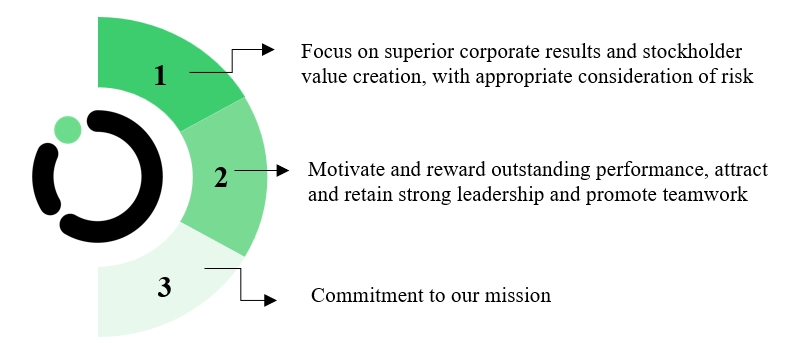
Primary Goals of our Executive Compensation Programs
Consistent with our principles, the primary goals of our executive compensation program are as follows:
| • | Attract, motivate and retain highly qualified and experienced executives who can execute our business plans in a fast-changing, competitive landscape. |
| • | Recognize and reward our executive officers fairly for achieving or
exceeding rigorous corporate and individual objectives. |
| • | Align the long-term interests of our executive officers with those of our
members and stockholders. |
Primary Elements of our 2025 Compensation Program
|
Element of
Pay
|
|
Form of
Compensation
|
|
|
Structure
|
|
Philosophy
|
|
Base Salary
|
Cash
|
•
|
Initially set through arm’s-length negotiation at the time of hiring, taking into account level of responsibility, qualifications,
experience, salary expectations and competitive market data.
|
Base salary is designed to be a competitive fixed component that establishes a guaranteed minimum level of cash compensation to
recognize and reward day-to-day contributions of our executive officers.
|
|||
|
•
|
Base salaries are then reviewed on an annual basis by the compensation and leadership committee and salary adjustments may be made
based on factors described below under “Roles of the Compensation and Leadership Committee, Management and the Compensation Consultant.”
|
||||||
|
|
|
|
|
|
|||
|
Annual
Cash
Incentive
|
Cash
|
•
|
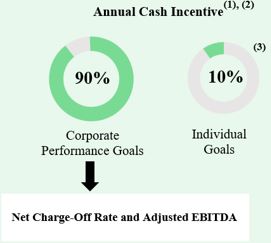
Annual cash incentive is based on a combination of financial and qualitative measures
 |
The performance-based cash compensation was designed to reward the achievement of annual corporate performance relative to
pre-established goals, as well as individual performance, contributions and strategic impact.
|
|||
|
Long-term
Equity
Incentive
|
Performance
Based Restricted
Stock Units (PSU)
|
 |
Long-term incentive compensation is an effective means for focusing our NEOs on driving increased stockholder value over a
multi-year period and motivating them to remain employed with us.
|
||||
|
Restricted Stock
Units (RSU)
|
|||||||
| (1) |
In December 2025, in order to promote executive retention and
leadership continuity, the compensation and leadership committee approved a special retention award for each of Ms. Layton and
Mr. Kirscht consisting of cash and time-based restricted stock unit awards. These retention awards were separate from and in addition to the Company’s regular annual cash incentive and long-term equity compensation programs. See “Special Retention Awards” below for additional details.
|
| (2) |
Mr. Kirscht was also eligible to participate in the Company’s MBO Cash Performance Program in 2025. See “MBO Cash
Performance Program” below for additional details.
|
| (3) |
The chart reflects the Former CEO’s annual cash incentive weighting. For the remaining NEOs, annual cash incentive weighting was 75% based on corporate
performance goals and 25% based on individual performance goals.
|
| (4) |
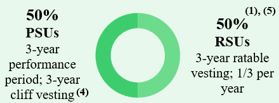
PSUs are determined based on Economic ROA for the first year of the
performance period and subject to a three-year relative total shareholder return (“TSR”) modifier; cliff vesting following
completion of the three-year period, subject to continued employment. See “Long-Term Incentive Compensation” below for
additional details.
|
| (5) |
The chart reflects the Former CEO’s annual long-term equity incentive allocation. For the remaining NEOs, annual long-term equity awards were allocated 60%
in RSUs and 40% in PSUs.
|
Fiscal 2025 Pay Mix
Each year, the compensation and leadership committee sets the key components of total compensation for executive officers: short-term cash
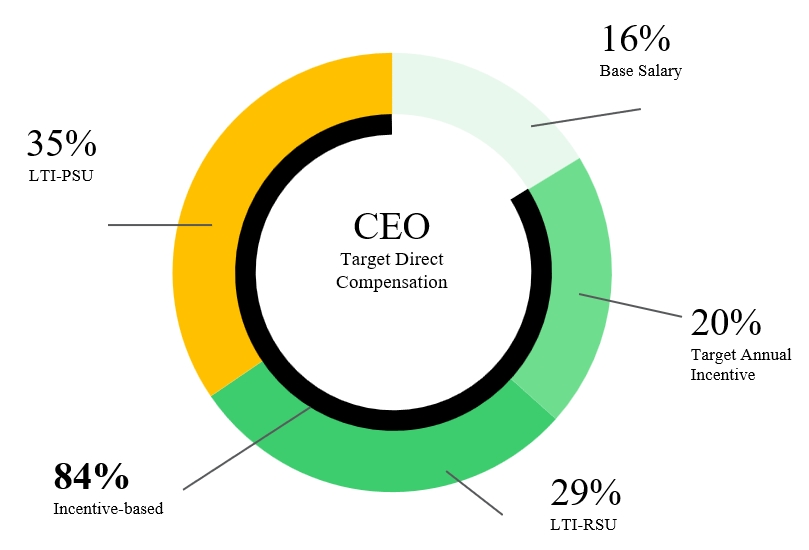
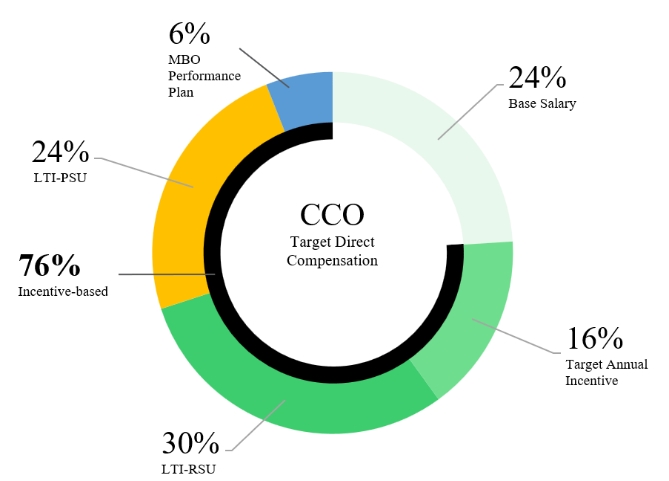
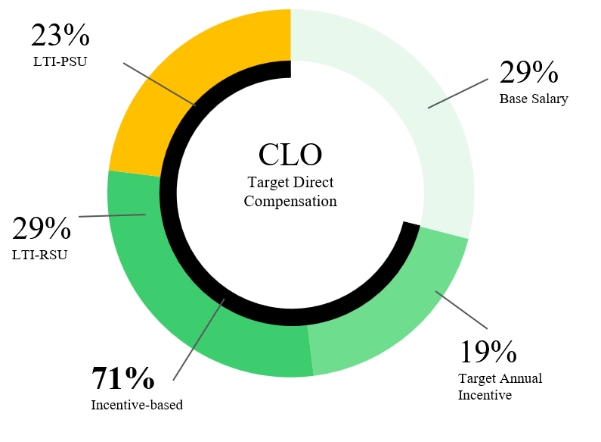
(annual base salary and incentive award) and long-term equity incentives (PSUs and RSUs). Together, these elements comprise the executive’s target total direct compensation. The target pay mix for fiscal 2025 for each NEO is shown below.
Our NEOs’ 2025 target total direct compensation decision focuses on variable and “at-risk” compensation that is closely aligned with Company
performance because the value earned is directly dependent upon our achievement of designated performance goals and/or stock performance. As shown in the charts below, “at-risk”, or incentive-based compensation, represents approximately 84% of
Former CEO Mr. Vazquez’s 2025 target total direct compensation, 76% for CCO Mr. Kirscht, and 71% for CLO Ms. Layton. These levels represent an increase compared to 2024, when “at-risk” compensation comprised approximately 68%, 62%, and 50% of
target total direct compensation for the Former CEO, CCO and CLO, respectively, reflecting the compensation and leadership committee’s continued emphasis on performance-based pay and the impact of changes in the Company’s stock price on the
value of equity awards.
For purposes of the charts below, compensation amounts are presented on a target basis and may differ from the amounts reported in the
“Summary Compensation Table.” Base salary reflects annualized base salary in effect for 2025 and annual incentive compensation reflects target opportunity (rather than actual payout). The long-term equity incentive amounts shown correspond to
the grant date fair value of such awards as reported in the “Summary Compensation Table” and exclude the special retention award consisting of cash and time-based restricted stock units granted to
each of Mr. Kirscht and Ms. Layton during 2025.
 |
 |
 |
Compensation Governance Policies and Practices
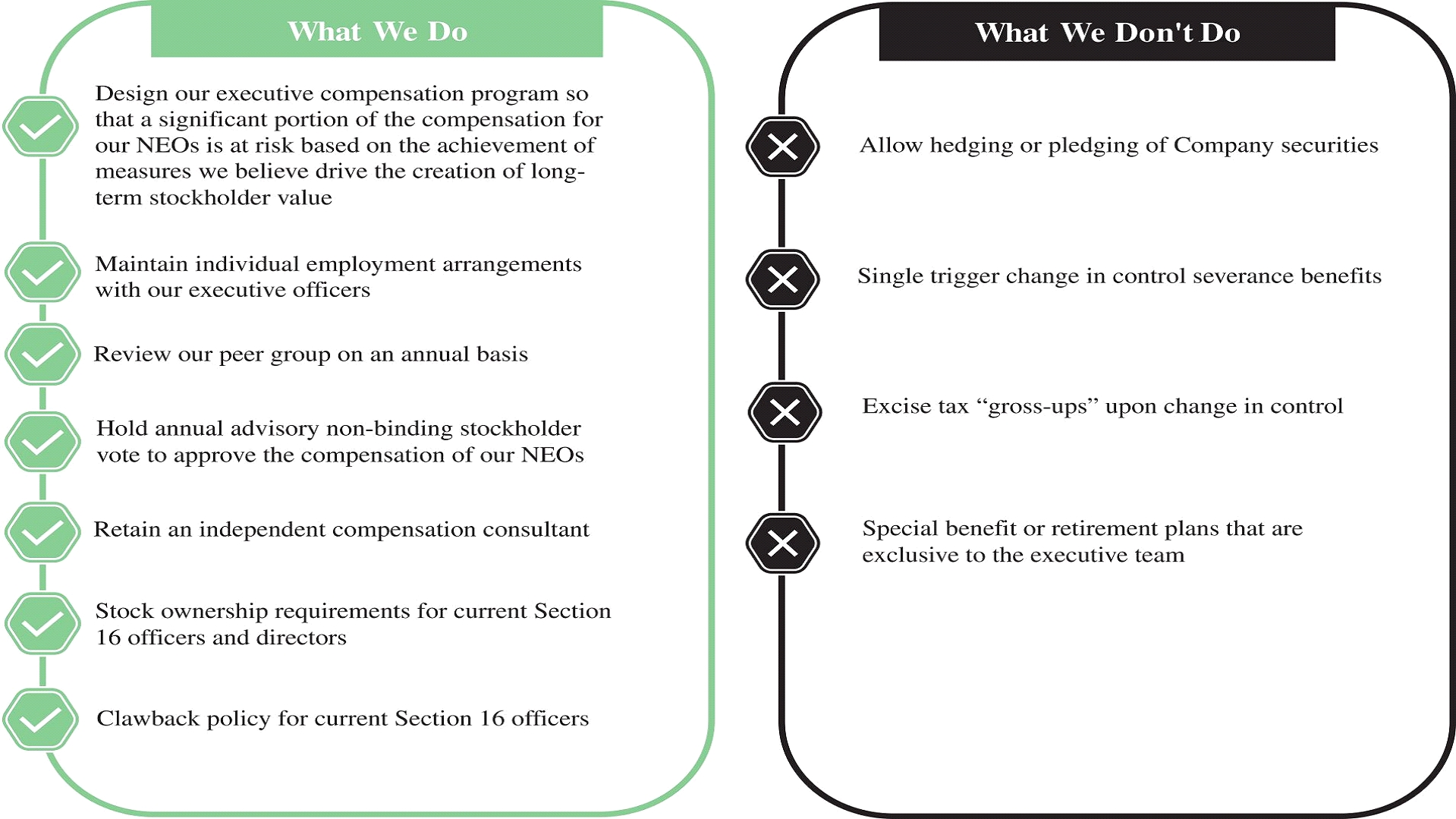
The Company’s executive compensation program is overseen by the compensation and leadership committee with the advice and support of the
Company’s independent compensation consultant as well as input from the Company’s management team. We have adopted executive compensation practices that promote performance, accountability, and alignment with stockholders, while avoiding those
we believe do not support the Company’s and stockholders’ long-term interests. The following summarizes those practices:
Roles of the Compensation and Leadership Committee, Management and the Compensation Consultant
|
Role of the
Compensation
and
Leadership
Committee
|
Each year, the compensation and leadership committee reviews and approves compensation decisions as
they relate to our NEOs and other senior management. The compensation and leadership committee, with input from management and its independent consultant, conducts a baseline review of our compensation programs to ensure alignment with
business needs and growth objectives. In this review, the independent compensation consultant is asked to provide a perspective on changing market practices as to compensation programs, with a particular focus on our identified peer
group and other companies with whom we compete directly for talent, as discussed below under “Role of Compensation Consultants” and “Use of Competitive Market Data.” Following this review, the compensation and leadership committee
considers the recommendations of our Chief Executive Officer, as discussed below under “Role of Management.” The compensation and leadership committee also manages the annual review process of our Chief Executive Officer, in cooperation
with our lead director, in which all members of our Board are asked to participate and provide perspective, resulting in a compensation and leadership committee determination regarding individual compensation adjustments for our Chief
Executive Officer. As part of this review of the compensation of our NEOs and other senior executive officers, the compensation and leadership committee considers several factors, including:
• Our corporate growth and other elements of financial performance;
• Individual performance and contributions to our business objectives;
• The executive officer’s experience and scope of duties;
• The recommendations of our
Chief Executive Officer (other than for himself) and other members of our
management team;
• Retention risk;
• Internal pay equity;
• An executive officer’s existing equity awards and stock holdings;
• Stockholder feedback, including the results of our annual say-on-pay vote and ongoing
engagement with stockholders; and
• Ensuring our incentive plans do not encourage undue risk-taking.
Our compensation and leadership committee relies on their judgment and extensive experience to establish an annual target total direct
compensation opportunity for each NEO that they believe will best achieve the goals of our executive compensation program and our short-term and long-term business objectives. The compensation and leadership committee retains
flexibility to review our compensation structure periodically as needed to focus on different business objectives.
|
|
Role of
Management
|
Our Chief Executive Officer works closely with the compensation and leadership committee in determining the compensation of our NEOs (other
than his own) and other executive officers. Each year, our Chief Executive Officer evaluates the performance of our NEOs and other executives and provides the compensation and leadership committee with recommendations on compensation
adjustments, promotions, bonus pool funding, goal attainment, and annual incentive payouts, except with respect to his own compensation. Our Chief Executive Officer also recommends corporate and individual performance goals for the
annual incentive plan, aligned with our business plan and strategy, for approval by the compensation and leadership committee. He also advises on the size, timing, and terms of equity awards and new hire compensation packages. These
recommendations from our Chief Executive Officer are often developed in consultation with finance and human resources members of his senior management team.
In certain situations, the compensation and leadership committee may elect to delegate specific responsibilities to our Chief Executive
Officer or a subcommittee, excluding any authority related to our executive officers. Our compensation and leadership committee has delegated to our Chief Executive Officer the authority to make employment offers to candidates at and
below the senior vice president level without seeking the approval of the compensation and leadership committee, subject to certain parameters. In addition, our compensation and leadership committee has delegated to a subcommittee,
currently made up of our Chief Executive Officer and CLO, the authority to approve certain equity grants to employees at and below the senior vice president level, subject to certain parameters approved by the compensation and
leadership committee.
At the request of the compensation and leadership committee, our Chief Executive Officer typically attends a portion of each compensation
and leadership committee meeting, including meetings at which the compensation and leadership committee’s compensation consultant is present. From time to time, various members of management and other employees, as well as outside legal
counsel and consultants retained by management, attend compensation and leadership committee meetings to make presentations and provide financial and other background information and advice relevant to compensation and leadership
committee deliberations. Our Chief Executive Officer and other NEOs do not participate in, and are not present during, any deliberations or determinations of our compensation and leadership committee regarding their compensation or
individual performance objectives.
|
|
Role of
Compensation
Consultants
|
The compensation and leadership committee is authorized under its charter to retain external advisors-such as compensation consultants,
legal counsel, and accounting experts-to assist in performance of its responsibilities. The compensation and leadership committee makes all determinations regarding the engagement, fees, and services of these external advisors, and any
such external advisor reports directly to the compensation and leadership committee.
During 2025, the compensation and leadership committee retained Willis Towers Watson as its independent compensation consultant to provide
support and advisory services as it relates to our compensation program. Willis Towers Watson performs no other services for us other than its work for the compensation and leadership committee. Willis Towers Watson complied with the
definition of independence under the Dodd-Frank Act and other applicable SEC and stock exchange regulations.
|
Use of Competitive Market Data
We strive to attract and retain top executive talent in a highly competitive market. To support this goal, the compensation and leadership
committee annually reviews market data for each executive role, including compensation practices at comparable public companies.
In addition to using published survey data for similar sized technology companies, the compensation and leadership committee approved a peer
group of comparable publicly traded companies, developed with the assistance of Willis Towers Watson, to aid it in assessing the overall competitiveness of our executive compensation program and the key components of compensation under the
program. The peer group was selected from publicly traded companies with (i) similar industry focus (i.e., consumer finance) (ii) comparable company scope and size, or (iii) that have similar product offerings. Our compensation and leadership
committee considered compensation data from the below-listed companies, which remained unchanged from last year. After the peer group was selected, MoneyLion was subsequently acquired and delisted from the New York Stock Exchange, which made it
no longer appropriate for benchmarking purposes for the remainder of the fiscal year.
|
Atlanticus
|
LendingClub
|
OppFi
|
SoFi Technologies
|
|
Enova International
|
LendingTree
|
PROG Holdings
|
Upstart Holdings
|
|
Green Dot
|
MoneyLion
|
Regional Management
|
World Acceptance
|
In connection with its annual review, the compensation and leadership committee, with the assistance of Willis Towers Watson, determined to
maintain a substantially similar peer group for the 2026 fiscal year, with the only change being the replacement of SoFi Technologies with NerdWallet.
Elements of Executive Compensation and 2025 Compensation Decisions
The key components of the target total direct compensation for each executive officer set by the compensation and leadership committee
annually are annual base salary, annual short-term cash incentive compensation and annual long-term equity incentive compensation (PSUs and RSUs). The compensation and leadership committee generally positions target total cash compensation and
annual equity compensation in a way that the committee believes substantially links executive compensation to corporate performance and strikes a balance between our short-term and long-term strategic goals. A significant portion of our NEOs’
target total direct compensation opportunity is comprised of “at-risk” compensation in the form of performance-based annual incentive opportunities and performance-based annual equity awards to align the NEOs’ incentives with the interests of
our stockholders and our corporate goals. The compensation and leadership committee believes that the target total direct compensation of our NEOs should be competitive within the markets in which we compete, while considering factors such as
individual performance, company performance and any unique circumstances of the NEO’s position based on that individual’s responsibilities and market factors. We believe that this target will enable us to attract, motivate and retain the
executive talent necessary to develop and execute our business strategy. The compensation and leadership committee reviews the compensation of our NEOs against our peer group, survey data sources, and other companies which we compete with for
talent to provide a general assessment of the overall competitiveness of our executive compensation program. We also provide our NEOs with certain severance and change in control benefits, as well as other benefits generally available to all
our employees, including retirement benefits under our 401(k) plan and participation in our employee benefit plans. In addition, in 2025, we granted a special retention award for each of Ms. Layton and Mr.
Kirscht, consisting of cash and time-based restricted stock unit awards, to promote retention and leadership continuity.
Base Salaries
Base salary is a fixed component of pay intended to recognize and reward the day-to-day contributions of our executive officers. Base salaries
are initially set at the time of hiring, taking into account level of responsibility, qualifications, experience, salary expectations and market data. Base salaries are then reviewed on an annual basis by the compensation and leadership
committee. The table below reflects changes in our NEOs’ salaries from the prior year.
|
Executives
|
2024 Annual Base
Salary ($)
|
2025 Annual Base
Salary ($)(1)
|
Change (%)
|
|||||||||
|
Raul Vazquez
|
595,000
|
(2) |
735,000
|
5.0
|
(3) |
|||||||
|
Kathleen Layton
|
390,000
|
420,000
|
7.7
|
|||||||||
|
Patrick Kirscht
|
485,346
|
510,000
|
5.1
|
|||||||||
| (1) |
The base salary amount for each of our NEOs is approved by the compensation and leadership committee.
|
| (2) |
In connection with certain operating expense reduction efforts by the Company, Mr. Vazquez voluntarily requested a 15% reduction of his annual base salary, effective November
11, 2023, which reduced his annualized base salary from $700,000 to $595,000. The voluntary reduction remained in effect throughout fiscal year 2024. Effective March 1, 2025, Mr. Vazquez’s annual base salary was reinstated to $700,000.
In connection with the Compensation and Leadership Committee’s annual review of executive compensation, his annual base salary was subsequently increased to $735,000 on a go-forward basis, also effective as of March 1, 2025.
|
| (3) |
Percentage change presented in the table reflects the increase from the reinstated base salary of $700,000 to $735,000, rather than from the temporarily reduced salary, in
order to provide a more meaningful year-over-year comparison of ongoing compensation.
|
Annual Incentive Plan
Each of our NEOs participated in our annual incentive plan for 2025. This performance-based cash compensation was designed to reward the
achievement of annual corporate performance relative to pre-established goals, as well as individual performance, contributions and strategic impact.
The compensation and leadership committee established target annual incentive opportunities for each NEO, expressed as a percentage of base
salary. The applicable target percentages for 2025 are described below.
|
2025 Target Annual Incentive Award Opportunity
|
||||||||
|
Target Award ($)
|
Percentage of Base
Salary (%)
|
|||||||
|
Raul Vazquez
|
918,750
|
125
|
||||||
|
Kathleen Layton
|
273,000
|
65
|
||||||
|
Patrick Kirscht
|
331,500
|
65
|
||||||
For 2025, the compensation and leadership committee approved the corporate performance goals of Adjusted EBITDA (65% weighting) and Annualized
Net Charge-Off Rate (35% weighting). Our compensation and leadership committee believes these are the appropriate drivers for our business as they provide a balance between growth and profitability and encourage operating efficiency.
Adjusted EBITDA measures the Company’s operating performance and profitability, while Annualized Net Charge-Off Rate—defined as annualized
loan losses (net of recoveries) divided by the average daily principal balance of owned loans—serves as a key indicator of credit performance. Together, these metrics allow the compensation and leadership committee to assess the Company’s
effectiveness, productivity and efficiency, while evaluating comparative results period-over-period. Please refer to the Reconciliation of Non-GAAP Financial Measures section of this Amendment for the Company’s definition of Adjusted EBITDA.
For each corporate performance goal, target achievement was set in accordance with our annual operating plan, with potential bonus funding
ranging from 0% to 150% of target, on a sliding scale. The Net Charge-Off Rate performance metric had a threshold payout of 50% at 115% of target, while the Adjusted EBITDA performance metric had a threshold payout of 50% at 85% of target.
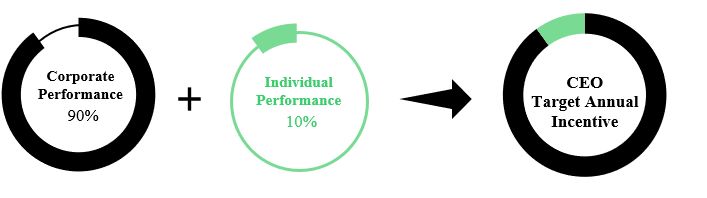
In 2025, the annual incentive awards were weighted 90% on corporate performance and 10% on attainment of individual goals for our Former CEO
and 75% on corporate performance and 25% on attainment of individual goals for Ms. Layton and Mr. Kirscht. Individual goal achievement for each NEO’s performance was determined by the compensation and leadership committee.
The following provides additional information regarding the corporate goals under our Annual Incentive Plan.
|
Performance Schedule (1)
|
||||||
|
Corporate Financial Metric &
Weighting
|
Threshold
|
Target
|
Maximum
|
Actual
|
Percent attainment
|
|
Net Charge-Off Rate and Adjusted EBITDA
|
Net Charge-Off Rate (35%)
|
13.1%
|
11.4%
|
9.7%
|
12.0%
|
78.9%
|
|
Adjusted EBITDA (65%)
|
$133M
|
$156M
|
$179M
|
$148M
|
81.5%
|
|
|
Total Corporate Attainment
|
80.6%
|
|||||
|
(1)
|
Attainment percentage between threshold, target, and maximum performance levels is determined based on a sliding-scale interpolation.
|
For a reconciliation of non-GAAP Adjusted EBITDA, refer to the Reconciliation on Non-GAAP Financial Measures section of this Amendment. For
more information about our business, please see “Business” and “Management’s Discussion and Analysis of Financial Condition and Results of Operations” in our Original Form 10-K.
Individual annual incentive award goals and achievement for our NEOs vary depending on the Company’s strategic priorities and each executive
officer’s responsibilities. While not exhaustive, below are certain key factors that the compensation and leadership committee, in consultation with our Former CEO, considered when determining the individual component of each 2025 annual
incentive award.
The compensation and leadership committee recognized the Company’s significant improvement in GAAP profitability in 2025 and meaningful
year-over-year improvement in operating and financial performance. The compensation and leadership committee determined that the NEOs played critical roles in executing against the Company’s strategic priorities of improving credit outcomes,
strengthening business economics and positioning the Company for sustainable, profitable growth.
In assessing individual performance, the compensation and leadership committee considered accomplishments including:
| • |
Leading disciplined credit management initiatives, including enhancements to underwriting standards, deployment of early default models and improved decisioning infrastructure,
and increasing the proportion of originations to returning members to support stable portfolio performance;
|
| • |
Strengthening business economics through operating expense reductions, improved operating leverage and enhanced capital efficiency;
|
| • |
Advancing balance sheet optimization efforts, including reducing corporate debt, lowering cost of capital, expanding warehouse capacity and maintaining access to diversified
funding sources;
|
| • |
Managing complex governance, regulatory and shareholder matters, including navigating a protracted proxy contest and heightened shareholder engagement, while maintaining
operational focus and compliance standards;
|
| • |
Supporting the continued expansion of secured personal loans and other strategic product initiatives designed to improve portfolio resiliency and long-term profitability; and
|
| • |
Providing strategic leadership during a period of macroeconomic uncertainty to maintain disciplined execution and advance long-term stockholder value creation.
|
As a result of the compensation and leadership committee’s performance review, the following annual incentive awards were paid to each of our
NEOs for 2025:
|
Target Bonus
($)
|
Bonus Payout
as a Percentage of Target
(%)
|
Actual Bonus
Amount
($)
|
||||||||||
|
Raul Vazquez
|
918,750
|
81.6
|
749,700
|
|||||||||
|
Kathleen Layton
|
273,000
|
85.5
|
233,279
|
|||||||||
|
Patrick Kirscht
|
331,500
|
81.0
|
268,349
|
|||||||||
In 2023, our compensation and leadership committee approved a one-time MBO cash performance award program for select then serving C-Suite
executives, excluding the Former CEO, which commenced in 2024.
The MBO Cash Performance Program operates independently from our annual incentive awards, though both are aligned in driving overall financial
and operational success. The MBO Cash Performance Program is intended to emphasize individual strategic objectives that are critical to each executive’s function and are tailored to drive long-term value creation and align with our broader
goals.
Under the program, MBOs are established annually over a three-year period (2024, 2025 and 2026), with each corresponding award payable in the
following year (2025, 2026 and 2027, respectively). Each equal annual installment is contingent upon the achievement of pre-established MBOs specific to the executive’s role and remains subject to the executives’ continued service. By tying
payouts to both time-based vesting and performance-based milestones, this structure enhances retention while ensuring sustained focus on key business initiatives.
Mr. Kirscht is the only NEO participating in the MBO Cash Performance Program. Under the MBO, Mr. Kirscht had the opportunity to earn an award
of up to $125,000 (payable in March 2026), if certain goals and objectives were attained by December 31, 2025. A portion of the MBO Cash Performance award was eligible to be received for partial achievement of any goal.
Mr. Kirscht’s 2025 performance goals were focused on credit performance, origination and loan quality metrics derived from the Company’s
annual operating plan and were weighted at 55%, 30% and 15%, respectively. These objectives were intended to reinforce disciplined underwriting, improve portfolio performance and support sustainable growth. Based on the compensation and
leadership committee’s evaluation, informed by the Former CEO’s assessment, Mr. Kirscht achieved approximately 81.5% of his target award for 2025, reflecting partial attainment of these goals.
The compensation and leadership committee determined that the MBO Cash Performance Program served its intended purpose as a targeted,
time-bound retention and performance vehicle and, accordingly, the program was not renewed for 2027 or future periods.
Long-Term Incentive Compensation
Our compensation and leadership committee believes long-term incentive compensation effectively aligns executive and stockholder interests,
driving sustained value creation. The program is designed to promote retention, support recruitment of key talent, and reward performance that maximizes long-term stockholder returns.
In 2025, our long-term incentive program provided for the delivery of long-term incentive awards through a combination of the following two
award vehicles:
|
LTI Vehicle
|
Vesting Terms
|
Weighting
|
|
Performance-based
Restricted Stock
Units (PSUs)
|
Performance based on Economic ROA for 2025; resulting units are subject to a three-year relative TSR modifier (2025–2027); cliff
vesting following completion of the three-year period (scheduled vesting March 10, 2028), subject to continued employment
|
Approximately 50% of total award (Former CEO)
/
40% (other NEOs)
|
|
Restricted Stock Units (RSUs)
|
RSUs vest in three equal annual installments from the vesting
commencement date of March 10, 2025, subject to continued
employment
|
Approximately 50% of total award (Former CEO)
/
60% (other NEOs)
|
The PSU award is designed to align executive compensation with both disciplined financial performance and long-term stockholder value
creation. Beginning with the 2025–2027 PSU award cycle, the compensation and leadership committee refined the PSU structure implemented in prior years to incorporate a combination of an internal financial performance metric and a relative
market-based modifier, rather than being based solely on absolute stockholder return. These refinements were intended to more closely align incentive outcomes with the Company’s evolving strategic priorities by reinforcing near-term financial
discipline while maintaining a strong linkage to long-term relative stockholder returns.
For this award cycle, initial performance is measured over a one-year period based on Economic Return on Assets (“Economic ROA”), as defined
in the applicable award agreement. The compensation and leadership committee selected Economic ROA because it believes this metric promotes capital discipline, balance sheet efficiency and sustainable earnings generation, which are critical
drivers of long-term value in the Company’s business model. A number of PSUs is calculated following the one-year performance period based on actual Economic ROA results relative to pre-established performance goals.
Any PSUs achieved based on Economic ROA performance are eligible to vest at the end of a three-year period subject to a relative total
shareholder return (“rTSR”) modifier. The rTSR modifier measures the Company’s total shareholder return relative to the Russell 3000 Index over a three-year performance period covering calendar years 2025 through 2027. The compensation and
leadership committee incorporated the rTSR modifier to ensure that realized payouts reflect the Company’s performance relative to the broader market and stockholder experience over the longer term. Following completion of the three-year rTSR
performance period, earned units may be adjusted upward or downward based on percentile performance relative to the index.
2025 Economic ROA Performance Scale
|
Economic ROA
|
% of Target PSUs Eligible
|
|
1.53% or greater
|
125%
|
|
1.32%
|
100%
|
|
1.11%
|
75%
|
|
0.90%
|
50%
|
|
0.71%
|
25%
|
|
Less than 0.71%
|
0%
|
Performance between the levels shown above is determined using linear interpolation.
Relative TSR Modifier (3-Year Performance Period)
|
Relative TSR Percentile vs. Russell 3000
|
Modifier (+/-25%)
|
|
≥ 75th percentile
|
125%
|
|
65th – 74th percentile
|
115%
|
|
55th – 64th percentile
|
110%
|
|
45th – 54th percentile
|
100%
|
|
35th – 44th percentile
|
90%
|
|
25th – 34th percentile
|
85%
|
|
< 25th percentile
|
75%
|
between the levels shown above is determined using linear interpolation. If the Company’s absolute TSR over the performance period is negative,
the modifier is capped at 100%.
The target number of PSUs granted reflects 100% achievement of both Economic ROA and the rTSR modifier. Actual payout may range from 0% to
156% of the target number of units, depending on performance. In addition to satisfying the applicable performance conditions, vesting remains subject to continued employment. Any units that become eligible for vesting based on our Economic ROA
results and our rTSR are scheduled to vest on March 10, 2028.
PSU Performance Certification
The compensation and leadership committee reviews and certifies PSU performance following the completion of the applicable performance
periods, with certification required within 45 days after the end of each performance period.
2023 PSU Awards
The PSU awards granted in 2023 were based on absolute TSR over the three-year performance period from January 1, 2023 through December 31,
2025. Based on the compensation and leadership committee’s certification of Company TSR for this period of negative 10.1%, no PSUs were eligible to be earned, and the awards were forfeited in full.
2025 PSU Awards
For the 2025–2027 PSU award cycle, initial performance is measured based on Economic ROA for fiscal year 2025. Based on the compensation and
leadership committee’s certification of Economic ROA of 0.99% for the period ended December 31, 2025, approximately 60.7% of the target PSUs became eligible units. These eligible units remain subject to further adjustment based on rTSR
performance over the three-year period ending December 31, 2027, and continued service through the applicable vesting date.
Special Cash and RSU Retention Awards
In December 2025, the compensation and leadership committee approved retention awards for certain executive officers, including to Ms. Layton
and Mr. Kirscht. The compensation and leadership committee determined these awards were critical to promote leadership continuity and stability during a period of heightened operational demands and execution of critical strategic priorities.
The compensation and leadership committee consulted with its independent compensation consultant to determine the appropriate form and amount of retention incentives, reviewed market data and evaluated multiple structures and alternatives
before approving an award consisting of a combination of cash and equity.
The retention awards consisted of (i) cash retention awards subject to continued service and (ii) RSU awards granted under the Company’s 2019
Equity Incentive Plan. The cash retention awards vest in two equal installments in September 2026 and June 2027, subject to continued employment through the applicable vesting dates. The RSU awards cliff vest based on continued service through
mid-2027. In addition, the retention awards are subject to certain acceleration rights, as more fully described in the section entitled “Employment, Severance and Change in Control Agreements – Retention
Awards” below.
The cash retention awards for Ms. Layton and Mr. Kirscht were $441,000 and $535,500, respectively, and RSUs were 86,043 and 95,603,
respectively. The grant date value of the RSUs were less than annual long-term equity awards, representing approximately 60% and 40% of the grant date value of the 2025 annual long-term equity awards granted to Ms. Layton and Mr. Kirscht,
respectively, in April 2025.
These retention awards were separate from and in addition to the Company’s regular annual cash incentive and long-term equity compensation
programs. The compensation and leadership committee views these awards as special grants designed to address specific retention considerations and does not intend for them to alter the Company’s ongoing annual compensation structure or target
pay mix.
Pursuant to SEC guidance, the cash retention awards will be reported in the Summary Compensation Table in the year in which the applicable
vesting conditions are satisfied. The RSU awards are reflected in the 2025 Summary Compensation Table at their grant date fair value.
Early 2026 Compensation Actions – Leadership Transition
Vazquez Transition Agreement
In connection with Mr. Vazquez’s transition and separation from the Company, he entered into a transition agreement and
release (the “Transition Agreement”) with us dated January 21, 2026 that was approved by the Board. Under the Transition Agreement, Mr. Vazquez agreed to remain as chief executive officer and a Board member until April 3, 2026, subject to the
terms of the Transition Agreement. During that time, Mr. Vazquez received his regular base salary, participated in the Company’s employee benefits, and his Company equity awards continued to vest. The Transition Agreement also provided that Mr.
Vazquez remained eligible to receive a bonus under the Company’s 2025 bonus plan provided that he remains employed with the Company through April 3, 2026.
Following his termination of employment on April 3, 2026, Mr. Vazquez executed a release agreement attached to the Transition
Agreement, which provides for the following separation benefits: (1) Mr. Vazquez will receive cash severance equal to $1,102,500, representing eighteen (18) months of his base annual salary, payable in equal installments over eighteen (18)
months; (2) Mr. Vazquez also will receive a lump sum payment equal to $918,750 multiplied by (a) the number of calendar days he is employed with us in 2026 as of his last day of employment divided by (b) 365; (3) the Company will cover the
premiums for COBRA coverage for Mr. Vazquez and his eligible dependents for a period of up to eighteen (18) calendar months following his last day of employment with us, subject to the terms of the Transition Agreement; and (4) (i) one hundred
percent (100%) of Mr. Vazquez’s outstanding and unvested time-based restricted stock units will immediately vest and settle, and (ii) if and to the extent any 2025 PSUs become eligible to vest based on Economic ROA achievement, then two-thirds
of such eligible 2025 PSUs will remain eligible to vest on the scheduled vesting date, subject to the terms and conditions of the applicable 2025 PSU agreements entered into by Mr. Vazquez, including any adjustments due to the application of
rTSR as described above, but in each case, disregarding any continued service or similar condition under the 2025 PSU agreement.
Following his termination of employment on April 3, 2026 and pursuant to his Transition Agreement, Mr. Vazquez is continuing
to provide service to us as a non-employee advisor through July 3, 2026 in order to promote a smooth and orderly transition of his duties. During this time, Mr. Vazquez receives a cash fee of $61,250 per month as payment for his services.
Office of the CEO Appointment
Effective as of April 4, 2026, in connection with Mr. Vazquez’s departure, Ms. Layton and Gaurav Rana, were appointed to serve
in the joint Office of the CEO of the Company. In this capacity, Ms. Layton and Mr. Rana served as the co-principal executive officers and as interim leaders of the Company until the permanent CEO was appointed. In connection with her
appointment to serve in the joint Office of the CEO, the compensation and leadership committee of the Board approved an additional $35,000 per month to Ms. Layton’s base salary, to be paid on top of her existing annual base salary of $450,000
(equivalent to $37,500 per month), for the period of time she served in the joint Office of the CEO.
Chief Executive Officer Appointment
On April 15, 2026, Doug Bland was appointed as Chief Executive
Officer and as a Director of the Company, effective as of April 20, 2026. In connection with his appointment and after consideration of a variety of factors, including
market data and recommendation from Willis Towers Watson the compensation and leadership committee approved an offer letter agreement with Mr. Bland pursuant to which he will be paid an annual base
salary of $750,000 and be eligible to receive an annual performance bonus with a target opportunity of 125% of his base salary. Mr. Bland will be granted a long-term new hire equity award with a total target grant date value of $5,000,000,
with approximately 50% of the target value allocated to RSUs and 50% of the target value allocated to PSUs, with RSUs vesting over a three-year period and PSUs eligible to vest after the end of the three-year performance period based on a
combination of the Company’s Economic ROA (as defined in the PSU Award Agreement) and the Company’s relative total stockholder return performance against the Russell 3000 Index over the three-year period, subject to earlier vesting upon
certain termination and change in control events. The offer letter also provides for a long-term cash retention award of $500,000 that will vest in three equal annual installments subject to Mr. Bland’s continued employment and a $500,000
cash signing bonus that will vest and be paid in four equal quarterly installments of $125,000 subject to Mr. Bland’s continuing employment, unless he experiences certain qualifying termination events. Mr. Bland will be eligible for benefits
under our executive change in control and severance policy.
Employment and Change in Control Arrangements
We have entered into at-will employment offer letters with each of our NEOs that were approved by the compensation and
leadership committee and our Board. In addition, we provide each NEO with the opportunity to receive certain severance payments and benefits in the event of a termination of employment under certain circumstances, including in connection with a
change of control. The compensation and leadership committee generally believes that the severance protection payments and benefits we offer are necessary to provide stability among our executive officers, serve to focus our executive officers
on our business operations, and avoid distractions in connection with a potential change in control transaction or period of uncertainty.
For additional information on the employment arrangements and potential post-employment payments to our NEOs, see “Employment, Severance, and Change in Control Agreements” and “Potential Payments and Benefits Upon Termination or Change in Control” below.
401(k) Plan and Employee Benefits
During 2025, all full-time employees in the United States employed by Oportun, including the NEOs, were eligible to
participate in the Company’s 401(k) plan, a tax qualified retirement plan. Other than the 401(k) plan, we do not provide defined benefit pension plans or defined contribution retirement plans to the NEOs or other employees.
We also offer a number of benefit programs to our full-time employees, including our NEOs, in the United States. These
benefits include medical, vision and dental insurance, health and dependent care flexible spending accounts, wellness programs, charitable donation matching, short-term and long-term disability insurance, accidental death and dismemberment
insurance, basic life insurance coverage, and business travel insurance. Full-time and part-time employees in the United States are eligible to receive paid parental leave.
Stock Ownership Guidelines
In April 2022, the compensation and leadership committee adopted stock ownership guidelines for our executive officers and
non-employee directors to further align their interests with our stockholders. Under these guidelines, each participant is required to own shares of our common stock with value of at least the following:
|
Position
|
Ownership Requirement
|
|
|
Chief Executive Officer
|
6x annual base salary
|
|
|
Other Section 16 officers
|
3x annual base salary
|
|
|
Non-employee directors
|
5x annual cash retainer
|
Covered executives are expected to meet the applicable ownership level within five years of the later of the adoption of the
guidelines or their hire or promotion into a covered role. Non-employee directors are expected to meet the applicable ownership level within five years of their appointment. Ownership levels are assessed annually based on the average closing
price of our common stock over the 20 trading days preceding December 31 of the applicable year. Shares that count toward the ownership requirement include shares held directly or indirectly (including through trusts or similar entities) and
“net shares” underlying full-value equity awards. Unvested time-based restricted stock units count at 50% of the underlying shares, and shares underlying awards that are subject to performance conditions do not count unless and until the
performance conditions have been achieved. Shares underlying stock options and other derivative securities do not count toward the ownership requirement. Until the applicable ownership level is achieved, executives and non-employee directors
are required to retain at least 50% of net shares received upon vesting or settlement of equity awards. The compensation and leadership committee may, in its discretion, grant exceptions or temporarily suspend the guidelines in cases of
hardship or other special circumstances.
All of our executive officers and non-employee directors are currently within the applicable phase-in period for achieving
their required ownership levels. As a result, none are required to have met the applicable ownership thresholds as of December 31, 2025, and several individuals have additional time to satisfy the guidelines based on their respective hire or
appointment dates.
Compensation Clawback
In April 2022, the compensation and leadership committee approved a discretionary executive clawback policy which applies to
our Section 16 officers. Our discretionary clawback policy provides that if (i) the Company is required to restate its financial statements filed pursuant to the Exchange Act as a result of a material error in the financial statement, (ii) such
restatement is due to the gross negligence or intentional misconduct of a clawback officer (as determined by the compensation and leadership committee), (iii) the amount of any cash-based incentive paid to or payable to such clawback officer
that was determined based on the achievement of financial or operating results would have been less if such financial statements had been correct at the time of determination, and (iv) no more than three years have elapsed from the filing date
of such financial statements upon which such incentive compensation was determined, then the Company shall recoup from such clawback officer an amount equal to such excess cash incentive compensation through such means as the compensation and
leadership committee determines in accordance with the policy.
In addition to the above-described discretionary clawback policy, in November 2023, the compensation and leadership committee
adopted a separate mandatory incentive-based executive clawback policy which applies to our current and former executive officers, on or after October 2, 2023. Our mandatory clawback policy provides for the recoupment of certain executive
compensation, regardless of whether the executive officer was at fault, including but not limited to short- and long-term incentive-based compensation, in the event of an accounting restatement resulting from material noncompliance with
financial reporting requirements under U.S. federal securities laws, consistent with SEC regulations effective in 2023. Under the policy, if an accounting restatement occurs, the Company is required to recover any incentive-based compensation
received by an executive officer that exceeds what would have been earned under the restated financial statements. The compensation and leadership committee administers the policy, determining the amount to be recovered and overseeing the
repayment process in accordance with the policy. Recovery methods may include direct reimbursement, offsetting against future compensation, cancellation of equity awards, or other legally permissible actions. Exceptions to the policy are
limited and apply only if recovery would be impracticable, such as when enforcement costs exceed the recoverable amount, or recovery would violate applicable laws.
Insider Trading Policy
We are committed to promoting high standards of ethical business conduct and compliance with applicable laws. As part of this
commitment, we have established an insider trading policy, governing the purchase, sale, and/or other disposition of our securities
by our directors, officers and employees, as well as their family members and entities controlled by them, that we believe is reasonably designed to promote compliance with insider trading laws, rules and regulations, and the exchange listing
standards applicable to us. A copy of our insider trading policy was filed as an Exhibit to our Original Form 10-K. We comply with insider trading laws, rules and regulations and any applicable listing standards in any transactions involving
our own securities.
Hedging and Pledging Policies
Our insider trading policy prohibits, among other things, all employees and non-employee directors from engaging in short sales or transactions in publicly-traded options (such as puts and calls) and other derivative securities
relating to our common stock, hedging or similar transaction designed to decrease the risks associated with holding our securities, pledging any of our securities as collateral for a loan, and holding any of our securities in a margin
account.
Delinquent Section 16(a) Reports
Section 16(a) of the Exchange Act requires our directors, officers, and persons who own more than 10% of our common stock to file reports of
ownership and changes in ownership of our common stock with the SEC. Based on the information available to us during the fiscal year ended December 31, 2025, we believe that all applicable Section 16(a) reports were timely filed, except for one
late Form 3 filing by each of Messrs. Wilcox and Schueller, each filed August 6, 2025. These filings were delayed due to administrative processing timing associated with obtaining SEC filing codes.
Practices and Policies Related to the Grant of Certain Equity Awards
While our Long-Term Incentive Compensation plan allows for the granting of stock options, stock appreciation rights, and similar option-like
awards, we have not awarded stock options, stock appreciation rights, or similar option-like awards in recent years to our executive officers or directors, and there were no stock options granted to or
exercised by our executive officers or directors in fiscal year 2025. Instead, long-term equity incentives are delivered through our PSUs and RSUs, which we believe better aligns with our pay-for-performance philosophy. Should the compensation and leadership committee determine that the award of stock options or similar option-like awards support our objectives in the future, grants will be made following a structured process aligned with our established equity grant policies and timing considerations.
In accordance with these practices and policies, during the fiscal year ended December 31, 2025, none of our NEOs were awarded
stock options with an effective grant date during any period beginning four business days before the filing or furnishing of a Form 10-Q, Form 10-K, or Form 8-K that disclosed material nonpublic information and ending one business day after the
filing or furnishing of such reports. During 2025, we have not timed the disclosure of material nonpublic information for the purpose of affecting the value of executive compensation.
Compensation Risk Assessment
The compensation and leadership committee has reviewed our compensation programs to assess whether they encourage our employees to take
excessive or inappropriate risks. After reviewing and assessing our compensation philosophy, policies and practices, including the mix of fixed and variable, short-term and long-term incentives and overall pay, incentive plan structures, and
the checks and balances built into, and oversight of, each plan and practice, the compensation and leadership committee has determined that any risks arising from our compensation programs are not reasonably likely to have a material adverse
effect on the Company.
Deductibility of Executive Compensation
Section 162(m) of the Internal Revenue Code generally places a $1 million limit on the amount of compensation a publicly-held company can
deduct for U.S. federal tax purposes in any tax year on compensation paid to “covered employees.” The compensation and leadership committee retains discretion to award compensation amounts which are not tax-deductible if it determines that such
compensation is consistent with our business needs and considers tax implications, including deductibility, as one of several factors in making compensation decisions.
Taxation of Parachute Payments and Deferred Compensation
We do not provide, and have no obligation to provide, any executive officer, including any NEO, with a “gross-up” or other reimbursement
payment for any tax liability that he or she might owe as a result of the application of Section 280G, 4999, or 409A of the Code. Sections 280G and 4999 of the Code provide that executive officers and directors who hold significant equity
interests and certain other service providers may be subject to an excise tax if they receive payments or benefits in connection with a change of control that exceed certain limits prescribed by the Code, and that the employer may be unable to
take a deduction on the amounts subject to this additional tax.
Summary Compensation Table
The following table provides information regarding the compensation awarded to, earned by or paid to our NEOs for the years ended December 31,
2025, 2024, and 2023:
|
|
Year |
Salary(1)
($)
|
Bonus
($)
|
Stock
Awards(3)
($)
|
Option
Awards(3)
($)
|
Non-Equity
Incentive Plan
Compensation(4)
($)
|
All Other
Compensation(5)
($)
|
Total
($)
|
|||||||||||||||||
|
Raul Vazquez(6)(7)
|
2025
|
716,155
|
-
|
2,862,000
|
-
|
749,700
|
-
|
4,327,855
|
|||||||||||||||||
|
Former Chief Executive Officer
|
2024
|
595,000
|
-
|
682,444
|
-
|
616,658
|
-
|
1,894,102
|
|||||||||||||||||
|
2023
|
687,885
|
-
|
746,007
|
-
|
225,680
|
34,963
|
1,694,535
|
||||||||||||||||||
|
Kathleen Layton
|
2025
|
414,231
|
-
|
1,220,615
|
-
|
233,279
|
-
|
1,868,125
|
|||||||||||||||||
|
Chief Legal Officer and Corporate Secretary
|
2024
|
387,173
|
-
|
136,491
|
-
|
267,252
|
-
|
790,917
|
|||||||||||||||||
|
2023
|
356,216
|
95,175
|
(2) |
371,545
|
-
|
47,795
|
15,362
|
886,093
|
|||||||||||||||||
|
Patrick Kirscht
|
2025
|
503,299
|
-
|
1,653,911
|
-
|
370,224
|
-
|
2,527,434
|
|||||||||||||||||
|
Chief Credit Officer
|
2024
|
483,115
|
-
|
360,845
|
-
|
445,759
|
-
|
1,289,720
|
|||||||||||||||||
|
2023
|
473,509
|
-
|
208,704
|
-
|
121,881
|
39,819
|
843,913
|
||||||||||||||||||
| (1) |
The salary amounts in this column reflect the blended salary paid, which takes into account any salary increases or decreases
effective during the year, if any. These amounts have been adjusted to reflect the blended salary paid and may deviate an immaterial amount from the previously reported salaries.
|
| (2) |
The amount reported represents an annual bonus paid to Ms. Layton during the course of 2023, prior to her promotion to Chief Legal
Officer. At the time, the bonus for non-executive employees was not based on pre-established performance criteria and therefore is not included in Non-Equity Incentive Plan Compensation.
|
| (3) |
This column reflects the aggregate grant date fair value of RSUs and
PSUs measured pursuant to FASB ASC 718 without regard to forfeitures and assuming the probable level of achievement for all PSUs. We value time-based RSUs based on the closing market price of our common stock reported on Nasdaq on the
grant dates. We value PSUs using the Monte Carlo simulation pricing model. In 2025, Messrs. Vazquez and Kirscht and Ms. Layton were granted PSUs having the following grant date fair values: $1,559,250 for Mr. Vazquez, $339,709 for Ms.
Layton, and $509,563 for Mr. Kirscht and. The value of the PSUs at the grant date assuming that the highest level of performance conditions will be achieved is $2,432,430 for Mr. Vazquez, $529,945 for Ms. Layton, and $794,918 for Mr.
Kirscht. The actual number of PSUs, if any, that may be earned range from 0% to 156% of the target number of units. For additional information on the assumptions used in calculating the grant date fair value of these awards see Note 2
and Note 11 to our Notes to the Consolidated Financial Statements included on our Original Form 10-K, as well as “Elements
of Executive Compensation and 2025 Compensation Decisions-Long-Term Incentive Compensation” above. These amounts in this column may not reflect
the actual economic value that may be realized by the NEO.
|
| (4) |
The amounts represent the bonuses paid under our annual incentive plan. For Mr. Kirscht, the amount also includes the bonus paid under
our MBO Cash Performance Program, as applicable.
|
| (5) |
The amounts reported include the cash value of Oportun’s match of our NEO’s contributions to the 401(k) plan in 2023, matching
charitable contributions made by Oportun in 2023 pursuant to the Company’s charitable match program, certain life insurance premium payments, and certain medical insurance and disability insurance payments. No 401(k) matching
contributions were provided to the NEOs for 2024 or 2025.
|
| (6) |
Mr. Vazquez was not paid additional compensation for his service on our Board.
|
| (7) |
Mr. Vazquez’ base salary was voluntarily decreased from $700,000 to
$595,000, effective November 11, 2023. The voluntary reduction remained in effect throughout fiscal year 2024. Effective March 1, 2025, Mr. Vazquez’s annual base
salary was reinstated to $700,000 and his annual base salary was subsequently increased to $735,000 on a go-forward basis, also effective as of March 1, 2025.
|
Grants of Plan-Based Awards in Fiscal Year 2025
The following table provides information regarding each grant of a plan-based award made to an NEO under any plan in the year ended December 31,
2025:
|
Estimated Future Payouts
Under Non-Equity
Incentive Plan Awards(1)
|
Estimated Future Payouts
Under Equity
Incentive Plan Awards
|
||||||||||||||||||||||||||||||||||
|
Type of
Award
|
Grant
Date
|
Threshold
($)
|
Target
($)
|
Maximum
($)
|
Threshold
(#)
|
Target
(#)
|
Maximum
(#)
|
All Other
Stock
Awards:
Number of
Shares
or Units
(#)
|
Grant Date
Fair Value
of Stock
Awards(2)
($)
|
||||||||||||||||||||||||||
|
Raul Vazquez
|
Annual
incentive
award
|
144,703
|
918,750
|
1,378,125
|
-
|
-
|
-
|
-
|
-
|
||||||||||||||||||||||||||
|
PSU
|
4/02/2025
|
-
|
-
|
-
|
42,188
|
225,000
|
351,000
|
-
|
1,559,250
|
||||||||||||||||||||||||||
|
RSU
|
4/02/2025
|
-
|
-
|
-
|
-
|
-
|
-
|
225,000
|
1,302,750
|
||||||||||||||||||||||||||
|
Kathleen Layton
|
Annual
incentive
award
|
35,831
|
273,000
|
409,500
|
-
|
-
|
-
|
-
|
-
|
||||||||||||||||||||||||||
|
PSU
|
4/02/2025
|
-
|
-
|
-
|
9,191
|
49,020
|
76,471
|
-
|
339,709
|
||||||||||||||||||||||||||
|
RSU
|
4/02/2025
|
-
|
-
|
-
|
-
|
-
|
-
|
73,530
|
425,739
|
||||||||||||||||||||||||||
|
RSU
|
12/31/2025
|
-
|
-
|
-
|
-
|
-
|
-
|
86,043
|
455,167
|
||||||||||||||||||||||||||
|
Patrick Kirscht
|
Annual
incentive
award
|
43,509
|
331,500
|
497,250
|
-
|
-
|
-
|
-
|
-
|
||||||||||||||||||||||||||
|
MBO
award
|
-
|
125,000
|
-
|
-
|
-
|
-
|
-
|
-
|
|||||||||||||||||||||||||||
|
PSU
|
4/02/2025
|
-
|
-
|
-
|
13,787
|
73,530
|
114,707
|
-
|
509,563
|
||||||||||||||||||||||||||
|
RSU
|
4/02/2025
|
-
|
-
|
-
|
-
|
-
|
-
|
110,295
|
638,608
|
||||||||||||||||||||||||||
|
RSU
|
12/31/2025
|
-
|
-
|
-
|
-
|
-
|
-
|
95,603
|
505,740
|
||||||||||||||||||||||||||
| (1) |
The target amounts shown in the column reflect the annual cash incentive compensation for which the executive was eligible to receive under our annual
incentive plan or MBO award program, respectively. The MBO award program does not contain a minimum threshold. Threshold amounts for the annual incentive plan represent 50% attainment of the Net-Charge Off Rate corporate performance
metric and 0% attainment for the remaining corporate performance and individual goals metrics. See “Compensation Discussion & Analysis – MBO Cash Performance
Program” for additional details.
|
| (2) |
This column reflects the aggregate grant date fair value of the RSU awards and PSU awards, assuming the probable level of achievement, measured pursuant to
FASB ASC 718, without regard to forfeitures. The assumptions used in calculating the grant date fair value of these awards are set forth in Note 2 and Note 11 to our Notes to the Consolidated Financial Statements included on our
Original Form 10-K. These amounts do not reflect the actual economic value that may be realized by the NEO.
|
Outstanding Equity Awards at 2025 Fiscal Year End
The following table provides information with respect to all outstanding stock options and RSUs held by our NEOs as of December 31, 2025. See “Employment, Severance, and Change in Control Agreements” and “Potential Payments and Benefits Upon Termination or Change in Control” below for information regarding
the impact of certain employment termination scenarios on outstanding equity awards.
|
Option Awards
|
Stock Awards
|
||||||||||||||||||||||||||||||||
|
Name
|
Award
Grant
Date(1)
|
Number of
Securities
Underlying
Unexercised
Options-
Unexercisable(2)
(#)
|
Number of
Securities
Underlying
Unexercised
Options-
Exercisable(3)
(#)
|
Option
Exercise
Price
($/sh)
|
Option
Expiration
Date
|
Number of
Shares or
Units That
Have Not
Vested
(#)
|
Market
Value of
Shares or
Units
That
Have Not
Vested(4)
($)
|
Equity
Incentive
Plan Awards:
Number of
Unearned
Shares, Units
or
Other Rights
That Have Not
Vested
(#)
|
Equity
Incentive
Plan Awards:
Market or
Payout Value
of
Unearned
Shares, Units
or
Other Rights
That Have Not
Vested(5)
($)
|
||||||||||||||||||||||||
|
Raul Vazquez
|
11/30/2016
|
-
|
145,453
|
19.69
|
11/29/2026
|
-
|
-
|
-
|
-
|
||||||||||||||||||||||||
|
|
6/28/2019 |
-
|
140,551
|
18.04
|
6/27/2029
|
-
|
-
|
-
|
-
|
||||||||||||||||||||||||
|
|
3/10/2020(6)
|
-
|
193,364
|
19.00
|
3/9/2030
|
-
|
-
|
-
|
-
|
||||||||||||||||||||||||
|
|
3/10/2021(6)
|
-
|
72,136
|
21.26
|
3/9/2031
|
-
|
-
|
-
|
-
|
||||||||||||||||||||||||
|
|
3/25/2022
|
6,973
|
104,575
|
13.39
|
3/24/2032
|
-
|
-
|
-
|
-
|
||||||||||||||||||||||||
|
|
3/25/2022
|
-
|
-
|
-
|
-
|
49,491
|
(4)
|
261,807
|
-
|
-
|
|||||||||||||||||||||||
|
|
12/6/2023
|
-
|
-
|
-
|
-
|
58,788
|
(7)
|
310,989
|
-
|
-
|
|||||||||||||||||||||||
|
|
12/6/2023
|
-
|
-
|
-
|
-
|
-
|
-
|
44,090
|
(10)
|
233,236
|
|||||||||||||||||||||||
|
|
06/14/2024
|
-
|
-
|
-
|
-
|
101,782
|
(8)
|
538,427
|
-
|
-
|
|||||||||||||||||||||||
|
|
06/14/2024
|
-
|
-
|
-
|
-
|
-
|
-
|
38,168
|
(11)
|
201,909
|
|||||||||||||||||||||||
|
|
4/2/2025
|
-
|
-
|
-
|
-
|
225,000
|
(9)
|
1,190,250
|
-
|
-
|
|||||||||||||||||||||||
|
|
4/2/2025
|
-
|
-
|
-
|
-
|
-
|
-
|
225,000
|
(12)
|
1,190,250
|
|||||||||||||||||||||||
|
Kathleen Layton
|
12/21/2016
|
-
|
8,522
|
19.69
|
12/20/2026
|
-
|
-
|
-
|
-
|
||||||||||||||||||||||||
|
|
11/29/2017
|
-
|
4,022
|
24.86
|
11/28/2027
|
-
|
-
|
-
|
-
|
||||||||||||||||||||||||
|
|
3/29/2018
|
-
|
3,935
|
25.41
|
3/28/2028
|
-
|
-
|
-
|
-
|
||||||||||||||||||||||||
|
|
3/10/2020(6)
|
-
|
9,164
|
19.00
|
3/9/2030
|
-
|
-
|
-
|
-
|
||||||||||||||||||||||||
|
|
3/10/2021(6)
|
-
|
5,857
|
21.26
|
3/9/2031
|
-
|
-
|
-
|
-
|
||||||||||||||||||||||||
|
|
3/10/2022
|
-
|
-
|
-
|
-
|
2,557
|
(4)
|
13,527
|
-
|
-
|
|||||||||||||||||||||||
|
|
3/10/2022(6)
|
1,081
|
16,202
|
13.26
|
3/9/2032
|
-
|
-
|
-
|
-
|
||||||||||||||||||||||||
|
|
9/10/2023
|
-
|
-
|
-
|
-
|
18,051
|
(4)
|
95,490
|
-
|
-
|
|||||||||||||||||||||||
|
|
06/14/2024
|
-
|
-
|
-
|
-
|
20,357
|
(8)
|
107,689
|
-
|
-
|
|||||||||||||||||||||||
|
|
06/14/2024
|
-
|
-
|
-
|
-
|
-
|
-
|
7,633
|
(11)
|
40,379
|
|||||||||||||||||||||||
|
|
04/02/2025
|
-
|
-
|
-
|
-
|
73,530
|
(9)
|
388,974
|
-
|
-
|
|||||||||||||||||||||||
|
|
04/02/2025
|
-
|
-
|
-
|
-
|
-
|
-
|
49,020
|
(12)
|
259,316
|
|||||||||||||||||||||||
|
|
12/31/2025
|
-
|
-
|
-
|
-
|
86,043
|
(13)
|
455,167
|
-
|
-
|
|||||||||||||||||||||||
|
Option Awards
|
Stock Awards
|
||||||||||||||||||||||||||||||||
|
Name
|
Award
Grant
Date(1)
|
Number of
Securities
Underlying
Unexercised
Options-
Unexercisable(2)
(#)
|
Number of
Securities
Underlying
Unexercised
Options-
Exercisable(3)
(#)
|
Option
Exercise
Price
($/sh)
|
Option
Expiration
Date
|
Number of
Shares or
Units That
Have Not
Vested
(#)
|
Market
Value of
Shares or
Units That
Have Not
Vested(4)
($)
|
Equity
Incentive
Plan Awards:
Number of
Unearned
Shares, Units or
Other Rights
That Have Not
Vested
(#)
|
Equity
Incentive
Plan Awards:
Market or
Payout Value
of
Unearned
Shares, Units
or
Other Rights
That Have Not
Vested(5)
($)
|
||||||||||||||||||||||||
|
Patrick Kirscht
|
11/30/2016
|
-
|
45,453
|
19.69
|
11/29/2026
|
-
|
-
|
-
|
-
|
||||||||||||||||||||||||
|
|
6/28/2019
|
-
|
70,275
|
18.04
|
6/27/2029
|
-
|
-
|
-
|
-
|
||||||||||||||||||||||||
|
|
3/10/2020(6)
|
-
|
82,871
|
19.00
|
3/9/2030
|
-
|
-
|
-
|
-
|
||||||||||||||||||||||||
|
|
3/10/2021(6)
|
-
|
30,916
|
21.26
|
3/9/2031
|
-
|
-
|
-
|
-
|
||||||||||||||||||||||||
|
|
3/25/2022
|
2,989
|
44,818
|
13.39
|
3/24/2032
|
-
|
-
|
-
|
-
|
||||||||||||||||||||||||
|
|
3/25/2022
|
-
|
-
|
-
|
-
|
21,211
|
(4)
|
112,206
|
-
|
-
|
|||||||||||||||||||||||
|
|
12/6/2023
|
-
|
-
|
-
|
-
|
16,447
|
(7)
|
87,005
|
-
|
-
|
|||||||||||||||||||||||
|
|
12/6/2023
|
-
|
-
|
-
|
-
|
-
|
-
|
12,334
|
(10)
|
65,247
|
|||||||||||||||||||||||
|
|
06/14/2024
|
-
|
-
|
-
|
-
|
53,818
|
(8)
|
284,697
|
-
|
-
|
|||||||||||||||||||||||
|
|
06/14/2024
|
-
|
-
|
-
|
-
|
-
|
-
|
20,181
|
(11)
|
106,757
|
|||||||||||||||||||||||
|
|
04/02/2025
|
-
|
-
|
-
|
-
|
110,295
|
(9)
|
583,461
|
-
|
-
|
|||||||||||||||||||||||
|
|
04/02/2025
|
-
|
-
|
-
|
-
|
-
|
-
|
73,530
|
(12)
|
388,974
|
|||||||||||||||||||||||
|
|
12/31/2025
|
-
|
-
|
-
|
-
|
95,603
|
(13)
|
505,740
|
-
|
-
|
|||||||||||||||||||||||
| (1) |
Awards with a grant date after July 31, 2015, but on or prior to September 26, 2019, were granted under our 2015 Stock Option/Stock
Issuance Plan. Awards with a grant date after September 26, 2019 were granted under our 2019 Equity Incentive Plan.
|
| (2) |
Each option grant provides for a four-year vesting schedule, with one-fourth of the underlying shares vesting on the one-year
anniversary of the vesting commencement date, and the balance vesting in equal monthly installments over the remaining 36 months, in each case subject to the executive’s continued service through the applicable vesting date. Except with
respect to stock options granted under our 2019 Equity Incentive Plan, options are exercisable immediately following grant, also known as “early exercisable,” and unvested shares purchased on an early exercise are subject to a
repurchase right in our favor on termination of employment that lapses along the same vesting schedule as contained in the option grant. This column reflects the number of unexercised options that were unvested as of December 31, 2025.
|
| (3) |
This column reflects the number of shares subject to unexercised options that were vested as of December 31, 2025.
|
| (4) |
The RSUs will vest over a four-year period with one-fourth of the RSUs vesting on each one-year anniversary of the vesting
commencement date, subject to the executive’s continued service on each such vesting date. There is no performance-based vesting condition associated with such RSUs.
|
| (5) |
Represents the number of unvested shares underlying RSUs or PSUs multiplied by the per share fair market value of our common stock as
of December 31, 2025, based on the closing price of our common stock of $5.29 per share.
|
| (6) |
Stock options granted under our 2019 Equity Incentive Plan are not early exercisable.
|
| (7) |
The RSUs will vest in 3 equal annual installments from the vesting commencement date of March 10, 2023, subject to the executive’s
continued service on each vesting date. There is no performance-based vesting condition associated with such RSUs.
|
| (8) |
The RSUs will vest in 3 equal annual installments from the vesting commencement date of March 10, 2024, subject to the executive’s
continued service on each vesting date. There is no performance-based vesting condition associated with such RSUs.
|
| (9) |
The RSUs will vest in 3 equal annual installments from the vesting commencement date of March 10, 2025, subject to the executive’s
continued service on each vesting date. There is no performance-based vesting condition associated with such RSUs.
|
| (10) |
These amounts represent PSU grants, assuming an achievement level at threshold. The actual number of PSUs, if any, that may be earned
range from 0% to 125% of the target number of units. Any PSUs that vest in excess of the Upside Units, may be paid out in cash. Vesting is also contingent upon the continued employment of the executive through March 10, 2026, or as
otherwise provided in the applicable award agreement.
|
| (11) |
These amounts represent PSU grants, assuming an achievement level at threshold. The actual number of PSUs, if any, that may be earned
range from 0% to 125% of the target number of units. Any PSUs that vest in excess of the Upside Units, may be paid out in cash. Vesting is also contingent upon the continued employment of the executive through March 10, 2027, or as
otherwise provided in the applicable award agreement.
|
| (12) |
These amounts represent PSU grants, assuming an achievement level at target. The actual number of PSUs, if any, that may be earned
range from 0% to 156% of the target number of units. Vesting is also contingent upon the continued employment of the executive through March 10, 2028, or as otherwise provided in the applicable award agreement or, in the case of Mr.
Vazquez, Transition Agreement. For additional information, see “Elements of Executive Compensation and 2025 Compensation Decisions-Long-Term Incentive Compensation” above.
|
| (13) |
The RSUs will cliff vest on June 30, 2027, subject to the executive’s continued service on each vesting date. There is no performance-based vesting condition associated with such RSUs.
|
Option Exercises and Stock Vested in Fiscal Year 2025
The following table presents information concerning the aggregate value and number of shares of our common stock for which options were exercised
or RSUs vested during 2025 for each of the NEOs:
|
Option Awards
|
Stock Awards(1)
|
||||||||||||
|
Name
|
Number of Shares
Acquired on Exercise
(#)
|
Value Realized on
Exercise
($)
|
Number of Shares
Acquired on Vesting
(#)
|
Value Realized on
Vesting
($)
|
|||||||||
|
Raul Vazquez
|
-
|
-
|
169,458
|
999,802
|
|||||||||
|
Kathleen Layton
|
-
|
-
|
31,946
|
193,355
|
|||||||||
|
Patrick Kirscht
|
-
|
-
|
68,974
|
406,947
|
|||||||||
| (1) | The number of shares and value realized on vesting include shares that were withheld or sold at the time of vesting to satisfy tax withholding requirements. |
Employment, Severance and Change in Control Agreements
We previously entered into offer letters with each of our NEOs that generally provide for at-will employment and set forth the executive’s
base salary, eligibility for an annual incentive award opportunity and employee benefits, and coverage under our executive severance policy. Each of our NEOs has also executed our standard form of proprietary information and invention
assignment agreement. Each NEO must abide by any applicable compensation recovery policy, stock ownership guidelines, or other similar policies that we maintain. Further, the award agreements governing the PSU awards granted to Messrs. Vazquez
and Kirscht in 2023 and Messrs. Vazquez and Kirscht and Ms. Layton in 2024 and 2025, provide for certain benefits upon a change in control or in the event of an involuntary termination of the applicable NEO in connection with a change in
control of Oportun. General provisions of the executive severance and change in control policy are discussed below, and any potential payments and benefits due upon a termination of employment or a change in control are further quantified below
in “Potential Payments and Benefits Upon Termination or Change in Control.”
Executive Severance and Change in Control Policy
We maintain an executive severance and change in control policy, which covers each of our NEOs.
Upon a termination of employment by us without cause or by the executive for good reason (an “involuntary termination”), our NEOs other than
our Chief Executive Officer will receive 12 months of salary continuation and continuation of health plan benefits at no cost under the Consolidated Omnibus Budget Reconciliation Act of 1985, as amended (“COBRA”) if they have been employed with
us for at least five years (or nine months of such benefits if they have been employed for less than five years). If the termination occurs during the period beginning 90 days before, through 12 months after, our change in control (the “change
in control period”), they will receive the higher level of salary continuation and health insurance benefits regardless of their tenure with us, their full target bonus, and full vesting of their unvested equity awards other than
performance-vested awards. For performance-vested awards (other than the PSU awards described in the following section), any acceleration of vesting, exercisability or lapse of restrictions is based on actual performance through the date of
such change in control. As of December 31, 2025, the last day of the most recently completed fiscal year, each of Ms. Layton and Mr. Kirscht had completed at least five years of employment with us.
On an involuntary termination, our Chief Executive Officer will receive 18 months of salary continuation and continuation of health plan
benefits at no cost under COBRA if he has been employed with us for at least five years (or 12 months of such benefits if he has been employed for less than five years), and 12 months’ worth of accelerated vesting of equity awards other than
performance-vested awards. If the involuntary termination occurs within the change in control period, he will receive the higher level of salary continuation and health insurance benefits regardless of his tenure with us, 150% of his target
bonus, and full vesting of his unvested equity awards other than performance-vested awards. For performance-vested awards (other than the PSU awards described in the following section), any acceleration of vesting, exercisability or lapse of
restrictions is based on actual performance through the date of such change in control. As of December 31, 2025, the last day of the most recently completed fiscal year, our Chief Executive Officer had completed at least five years of
employment with us. The Transition Agreement superseded the Chief Executive Officer’s rights to severance under his employment agreement.
Severance benefits are subject to the execution of a release of claims by the executive, resignation from all officer and director positions,
and continued compliance with the executive’s obligations under any confidentiality, intellectual property assignment, non-solicitation and restrictive covenant agreement with us. The terms “cause,” “good reason” and “change in control” can be
found in the executive severance and change in control policy. If the payments and benefits under our executive severance and change in control policy would constitute “parachute payments” within the meaning of Section 280G of the Internal
Revenue Code and would be subject to the related excise tax, such payments either will be paid in full or as to such lesser amount that would result in no portion of the payments and benefits being subject to such excise tax, whichever results
in the greater amount of after-tax benefits to the NEO after taking into account any applicable excise tax. Our executive severance and change in control policy does not provide for any Internal Revenue Code Section 280G-related tax gross-up
payments from the Company.
Retention Awards
As described above under “Special Retention Awards,” Mr. Kirscht and Ms. Layton received special
retention awards consisting of both a cash retention award and a time-based RSU retention award. The cash retention awards vest in installments in 2026 and 2027, subject to continued service. Under the terms of the applicable award agreements,
any unvested portion of a cash retention award will accelerate in full upon (i) a Change in Control (as defined in the Executive Severance and Change in Control Policy) that occurs prior to the executive’s termination of service or (ii) a
Qualifying Termination (as defined in such policy), in each case subject to the executive’s execution and non-revocation of a release of claims. The RSU retention awards are scheduled to cliff vest on June 30, 2027, subject to continued
service. Under the terms of the applicable RSU retention award agreements, 100% of the unvested RSUs will accelerate and vest in full upon a Qualifying Termination, subject to the executive’s execution and non-revocation of a release of claims
and continued compliance with applicable confidentiality and restrictive covenant obligations. This acceleration right applies regardless of whether a Change in Control has occurred. These retention awards are separate from, and in addition to,
the benefits provided under the Executive Severance and Change in Control Policy described above.
PSU Award Agreement
Under each of the award agreements governing the PSU awards granted in 2023 to Messrs. Vazquez and Kirscht, and in 2024 and 2025 to all of our
NEOs, if a “change in control” (as defined in the PSU award agreement) occurs during the applicable three-year performance period, the performance period will be shortened to conclude as of a date, determined by the compensation and leadership
committee, that is within the 10-day period ending with the estimated date of the change in control, and the compensation and leadership committee will certify our TSR performance (or relative TSR performance, in the case of 2025 PSUs) during
the abbreviated performance period by comparing the beginning average closing price to the consideration payable in the change in control (instead of the average closing price for the last 20 trailing consecutive trading days).
If the applicable NEO continues to provide service to us through the date of the change in control, then as of immediately before the change
in control, a number of PSUs will become eligible PSUs equal to the greater of (x) the number of PSUs, if any, that the compensation and leadership committee determined may become eligible PSUs according to the certification described above, or
(y) 100% of the target number of PSUs.
If the change in control occurs while the NEO continues to provide service to us and the PSU award is not assumed, continued, or substituted
by a similar award, 100% of the NEO’s eligible PSUs (as determined according to the certification described above) will vest as of immediately before the change in control.
In addition, if, during the period beginning 90 days before a change in control and ending 12 months after that change in control, the NEO’s
employment with us is terminated either (a) by us without “cause” and other than due to their death or “disability,” or (b) by the NEO for “good reason” (as such terms are defined in the PSU agreement), 100% of the NEO’s eligible PSUs will
vest, subject to the NEO’s execution of a release of claims by the executive, resignation from all officer and director positions, and continued compliance with the executive’s obligations under any confidentiality, intellectual property
assignment, non-solicitation and restrictive covenant agreement with us. The vesting acceleration benefits under our executive severance and change in control policy will not apply to these PSU awards.
Potential Payments and Benefits Upon Termination or Change in Control
The following table sets forth the estimated payments and benefits that would be received by each of the NEOs upon a change in control of
Oportun, upon a termination of employment without cause or following a resignation for good reason (which we refer to below as an involuntary termination) unrelated to a change in control, or upon an involuntary termination in connection with a
change in control of Oportun. This table reflects amounts payable to each NEO assuming his or her employment was terminated on December 31, 2025, and/or the change in control also occurred on that date. For additional discussion of the
potential benefits and payments due in connection with a termination of employment or a change in control, please see “Employment, Severance, and Change in Control Agreements-Executive Severance and Change in Control Policy” above.
|
Name
|
Change in
Control(1)(2)(3)(4)
($)
|
Involuntary
Termination Other
than During
Change in Control
Period(2)(3)(4)
($)
|
Involuntary
Termination During
Change in Control
Period(2)(3)(4)
($)
|
|||||||||
|
Raul Vazquez
|
||||||||||||
|
Salary Severance(4)
|
-
|
1,102,500
|
1,102,500
|
|||||||||
|
Bonus Severance(4)
|
-
|
-
|
1,378,125
|
|||||||||
|
Continuation of Health Insurance Benefits
|
-
|
41,778
|
41,778
|
|||||||||
|
Accelerated Vesting of Cash Awards
|
-
|
-
|
-
|
|||||||||
|
Accelerated Vesting of Equity Awards
|
2,930,835
|
1,238,754
|
5,232,307
|
|||||||||
|
Total(5)
|
2,930,835
|
2,383,032
|
7,754,710
|
|||||||||
|
Kathleen Layton
|
||||||||||||
|
Salary Severance
|
-
|
420,000
|
420,000
|
|||||||||
|
Bonus Severance
|
-
|
-
|
273,000
|
|||||||||
|
Continuation of Health Insurance Benefits
|
-
|
-
|
-
|
|||||||||
|
Accelerated Vesting of Cash Awards
|
441,000
|
441,000
|
441,000
|
|||||||||
|
Accelerated Vesting of Equity Awards
|
420,846
|
455,167
|
1,481,692
|
|||||||||
|
Total
|
861,846
|
1,316,167
|
2,615,692
|
|||||||||
|
Patrick Kirscht
|
||||||||||||
|
Salary Severance
|
-
|
510,000
|
510,000
|
|||||||||
|
Bonus Severance
|
-
|
-
|
331,500
|
|||||||||
|
Continuation of Health Insurance Benefits
|
-
|
27,852
|
27,852
|
|||||||||
|
Accelerated Vesting of Cash Awards
|
535,500
|
535,500
|
535,500
|
|||||||||
|
Accelerated Vesting of Equity Awards
|
1,077,018
|
505,740
|
2,650,126
|
|||||||||
|
Total
|
1,612,518
|
1,579,092
|
4,054,978
|
|||||||||
| (1) |
The values listed in this column for “Equity Awards” reflect the estimated value of the PSUs granted to the applicable NEO that would
become eligible PSUs (that is, eligible to vest on March 10, 2026, March 10, 2027, or March 10, 2028 subject to the NEO continuing to provide service following the change in control through that date) if a change in control occurred on
December 31, 2025 (which was during each PSU award’s three-year performance period). This estimated value was calculated by multiplying the number of eligible PSUs by the closing price for a share of our common stock on December 31,
2025 (the last business day of our 2025 fiscal year), which was $5.29. The number of eligible PSUs is assumed to be the target number of PSUs since the number of PSUs that would become eligible PSUs based on our TSR performance during
the abbreviated performance period was less than the target number of PSUs.
|
| (2) |
Based on salary and target bonus amounts as of December 31, 2025.
|
| (3) |
The values listed in this column for “Cash Awards” reflect the estimated value of accelerated vesting of the applicable NEO’s
outstanding cash retention awards granted in December 2025. These cash retention awards are subject to service-based vesting and are not reflected in the 2025 Summary Compensation Table.
|
| (4) |
The values listed in this column for “Equity Awards” reflect the
estimated value of accelerated vesting of the applicable NEO’s equity awards, including the special retention awards, which was calculated by multiplying the number of shares underlying the NEO’s
unvested option, RSU awards or PSU awards that would be accelerated by the closing price for a share of our common stock on December 31, 2025 (the last business day of our 2025 fiscal year), which was $5.29, minus the aggregate
exercise price attributable to the accelerated shares in the case of a stock option. No value has been included for stock options that have a per share exercise price at or above $5.29. For the PSU awards granted to Messrs. Vazquez
and Kirscht in 2023 and Messrs. Vazquez and Kirscht and Ms. Layton in 2024 and 2025, the number of PSUs accelerated is assumed to be the target number of PSUs since the number of PSUs that would become eligible PSUs based on our TSR
performance during each abbreviated performance period was less than the target number of PSUs.
|
| (5) |
The values listed in the above table are estimates only, assuming employment was terminated on December 31, 2025 or the change of control occurred on December 31, 2025. For a description of the actual compensation payable in
connection with Mr. Vazquez’s transition in 2026, see the section entitled “Early 2026 Compensation Actions – Leadership Transition—Vazquez Transition Agreement.”
|
Report of the Compensation and Leadership Committee
The compensation and leadership committee has reviewed and discussed the “Executive Compensation” section with management. Based on this
review and discussion, the compensation and leadership committee has recommended to the Board that the “Executive Compensation” section be included in our Annual Report on Form 10-K/A for the fiscal year ended December 31, 2025 and our proxy
statement for our 2026 annual meeting of stockholders.
Respectfully submitted by the members of the compensation and leadership committee of the Board:
Mohit Daswani (Chair)
Ginny Lee
Warren Wilcox
Reconciliation on Non-GAAP Financial Measures
This Amendment contains financial measures that are not calculated in accordance with U.S. generally accepted accounting principles (“GAAP”).
Adjusted EBITDA
Adjusted EBITDA is a non-GAAP financial measure defined as our net income, adjusted to eliminate the effect of certain items as described
below. We believe that Adjusted EBITDA is an important measure because it allows management, investors and our Board to evaluate and compare our operating results, including our return on capital and operating efficiencies, from
period-to-period by making the adjustments described below. In addition, it provides a useful measure for period-to-period comparisons of our business, as it removes the effect of taxes, certain non-cash items, variable charges and timing
differences.
|
•
|
We believe it is useful to exclude the impact of income tax expense (benefit), as reported, because historically it has included irregular income tax items that do not reflect ongoing business operations. |
|
•
|
We believe it is useful to exclude the impact of interest expense associated with the Company’s corporate financing, as we view this expense as related to our capital structure rather than our funding. |
|
•
|
We believe it is useful to exclude the impact of depreciation and amortization and stock-based compensation expense because they are non-cash charges. |
|
•
|
We believe it is useful to exclude the impact of certain non-recurring charges, such as expenses associated with our workforce optimization, acquisition and integration related expenses, and other non-recurring charges because these items do not reflect ongoing business operations. Other non-recurring charges include litigation reserve, impairment charges, debt amendment and warrant amortization costs related to our Corporate Financing. |
|
•
|
We also reverse origination fees for Loans Receivable at Fair Value, net. We recognize the full amount of any origination fees as revenue at the time of loan disbursement in advance of our collection of origination fees through principal payments. As a result, we believe it is beneficial to exclude the uncollected portion of such origination fees, because such amounts do not represent cash that we received. |
|
•
|
We also reverse the fair value mark-to-market adjustment because it is a non-cash adjustment. |
The following table presents a reconciliation of Net Income (loss) to Adjusted EBITDA for the years ended December 31, 2025 and 2024:
|
Year Ended December 31,
|
||||||||
|
Adjusted EBITDA (in thousands)
|
2025
|
2024
|
||||||
|
Net income (loss)
|
$
|
25,246
|
$
|
(78,682
|
)
|
|||
|
Adjustments:
|
||||||||
|
Income tax expense (benefit)
|
18,830
|
(36,495
|
)
|
|||||
|
Interest on corporate financing
|
35,729
|
51,135
|
||||||
|
Depreciation and amortization
|
41,470
|
52,186
|
||||||
|
Stock-based compensation expense
|
10,686
|
13,053
|
||||||
|
Other non-recurring charges(1)
|
16,579
|
34,019
|
||||||
|
Fair value mark-to-market adjustment
|
(115
|
)
|
69,331
|
|||||
|
Adjusted EBITDA
|
$
|
148,425
|
$
|
104,547
|
||||
| (1) |
Certain prior-period financial information has been reclassified to conform to current period presentation.
|
Adjusted Net Income (Loss)
Adjusted Net Income is a non-GAAP financial measure defined as net income adjusted to eliminate the effect of certain items as described
below.
|
•
|
We believe that Adjusted Net Income is an important measure of operating performance because it allows management, investors, and our Board to evaluate and compare our operating results, including return on capital and operating efficiencies, from period to period, excluding the after-tax impact of non-cash, stock-based compensation expense and certain non-recurring charges. |
|
•
|
We believe it is useful to exclude the impact of income tax expense (benefit), as reported, because historically it has included irregular income tax items that do not reflect ongoing business operations. We also include the impact of normalized income tax expense by applying a normalized statutory tax rate. |
|
•
|
We believe it is useful to exclude the impact of certain non-recurring charges, such as expenses associated with our workforce optimization, and other non-recurring charges because we do not believe that these items reflect our ongoing business operations. Other non-recurring charges include litigation reserve, impairment charges, debt amendment and warrant amortization costs related to our corporate financing facilities. |
|
•
|
We believe it is useful to exclude stock-based compensation expense because it is a non-cash charge. |
|
•
|
We also exclude the fair value mark-to-market adjustment on our asset-backed notes carried at fair value to align with the 2023 accounting policy decision to account for new debt financings at amortized cost. |
The following table presents a reconciliation of Net Income (loss) to Adjusted Net Income for the years ended December 31, 2025 and 2024:
|
As of or for the Year Ended December 31,
|
||||||||
|
Adjusted Net Income (Loss) (in thousands)
|
2025
|
2024
|
||||||
|
Net income (loss)
|
$
|
25,246
|
$
|
(78,682
|
)
|
|||
|
Adjustments:
|
||||||||
|
Income tax expense (benefit)
|
18,830
|
(36,495
|
)
|
|||||
|
Stock-based compensation expense
|
10,686
|
13,053
|
||||||
|
Other non-recurring charges (1)
|
16,579
|
34,019
|
||||||
|
Net decrease in fair value of credit cards receivable
|
—
|
36,177
|
||||||
|
Mark-to-market adjustment on asset-backed notes
|
17,820
|
72,089
|
||||||
|
Adjusted income (loss) before taxes
|
89,161
|
40,161
|
||||||
|
Normalized income tax expense
|
24,073
|
10,843
|
||||||
|
Adjusted Net Income (Loss)
|
$
|
65,088
|
$
|
29,318
|
||||
|
Income tax rate (2)
|
27.0
|
%
|
27.0
|
%
|
||||
| (1) | Certain prior-period financial information has been reclassified to conform to current period presentation. |
| (2) | Income tax rates for the years ended December 31, 2025 and December 31, 2024, are based on a normalized statutory rate. |
Adjusted Earnings Per Share
Adjusted Earnings (Loss) Per Share is a non-GAAP financial measure defined as Adjusted Net Income divided by weighted average diluted shares
outstanding. We believe Adjusted Earnings (Loss) Per Share is an important measure because it allows management, investors and our Board to evaluate the operating results, operating trends and profitability of the business in relation to
diluted adjusted weighted-average shares outstanding.
The following table presents a reconciliation of Diluted EPS to Diluted Adjusted EPS for the years ended December 31, 2025 and 2024. For the
reconciliation of net income to Adjusted Net Income (Loss), see the immediately preceding table “Adjusted Net Income (Loss).”
|
As of or for the Year Ended December 31,
|
||||||||
|
(in thousands, except share and per share data)
|
2025
|
2024
|
||||||
|
Diluted earnings (loss) per share
|
$
|
0.53
|
$
|
(1.95
|
)
|
|||
|
Adjusted Earnings Per Share
|
||||||||
|
Adjusted Net Income
|
65,088
|
29,318
|
||||||
|
Basic weighted-average common shares outstanding
|
46,418,934
|
40,356,025
|
||||||
|
Weighted average effect of dilutive securities:
|
||||||||
|
Stock options
|
—
|
—
|
||||||
|
Restricted stock units
|
1,439,697
|
500,705
|
||||||
|
Diluted Adjusted weighted-average common shares outstanding
|
47,858,631
|
40,856,730
|
||||||
|
Adjusted Earnings Per Share
|
$
|
1.36
|
$
|
0.72
|
||||
Non-Employee Director Compensation
We compensate non-employee directors for their service on our Board with a combination of cash and equity awards, the amounts of which are
commensurate with their role and involvement. Directors may be reimbursed for travel, food, lodging and other expenses directly related to their activities as directors. Directors are also entitled to the protection provided by their
indemnification agreements and the indemnification provisions as described in our amended and restated certificate of incorporation and amended and restated bylaws.
The compensation and leadership committee, which is comprised solely of independent directors, has the primary responsibility for reviewing
and recommending to the Board the type and amount of compensation as well as changes to the compensation to be paid or awarded to non-employee directors, including any consulting, retainer, Board meeting, committee and committee chair fees and
equity awards.
Cash Compensation
Each non-employee director receives an annual cash retainer for his or her service on the Board, as well as additional cash retainers if he or
she serves as the Lead Independent Director, on a committee or as the chair of a committee. For new directors, these amounts are prorated for partial-year service based on the date of election to the Board. All cash payments to non-employee
directors who served in the relevant capacity at any point during the immediately preceding prior fiscal quarter will be paid quarterly in arrears on a prorated basis. A non-employee director who served in the relevant capacity during only a
portion of the prior fiscal quarter will receive a prorated payment of the quarterly payment of the applicable cash retainer. The following table lists the cash retainer amounts in effect during fiscal year 2025, starting on July 18, 2025.
|
Position
|
Annual Cash Retainer ($)
|
|||
|
Board member
|
50,000
|
|||
|
Lead Independent Director
|
25,000
|
|||
|
Audit and risk committee chair
|
20,000
|
|||
|
Audit and risk committee member
|
10,000
|
|||
|
Other committee chair
|
15,000
|
|||
|
Other committee member
|
7,500
|
|||
The following table lists the cash retainer amounts in effect during fiscal year 2025, prior to July 18, 2025.
|
Position
|
Annual Cash Retainer ($)
|
|||
|
Board member
|
34,000
|
|||
|
Lead Independent Director
|
21,250
|
|||
|
Audit and risk committee chair
|
17,000
|
|||
|
Audit and risk committee member
|
8,500
|
|||
|
Other committee chair
|
12,750
|
|||
|
Other committee member
|
6,375
|
|||
Equity Compensation
Each then-serving non-employee director received an annual award of RSUs with a value of $125,000 immediately following the
2025 annual meeting of stockholders. Following the appointment of our Lead Independent Director, an additional RSU award with a target value of $25,000 was granted and the award was prorated to reflect the portion of the annual service period
remaining at the time of appointment. The number of shares subject to the RSUs granted at the annual meeting was determined based on the annual equity award value divided by the thirty-day trailing average of the closing price of the Company’s
common stock as of the closing price on the day prior to the date of grant and rounded up to the nearest full share, resulting in an award of RSUs covering 18,090 shares of our common stock for each non-employee director. The additional RSU
award granted in connection with the Lead Independent Director appointment was determined using the same methodology, subject to proration as described above, resulting in an award of RSUs covering 3,644 shares of our common stock. The RSU
awards vest over one year on a quarterly basis, commencing on the date of the 2025 annual meeting, subject to the non-employee director continuing to provide services through each applicable vesting date. A non-employee director who is newly
appointed to the Board other than in connection with an annual meeting of stockholders will receive a grant of RSUs upon appointment (an “Initial Director Award”). The number of shares subject to each Initial Director Award is determined based
on the annual equity award value divided by the thirty-day trailing average of the closing price of the Company’s common stock on the grant date and rounded up to the nearest full share, and the award is prorated based on the portion of the
one-year period remaining since the last annual meeting.
Non-employee directors are required to hold equity equal to five times their annual cash retainer and are expected to meet such ownership
levels within five years of the later of the adoption of the guidelines or their appointment. See “Stock Ownership Guidelines” above for additional information.
Non-Employee Director Compensation Table for Fiscal Year 2025
The following table provides information regarding all compensation awarded to, earned by or paid to our non-employee directors for the year
ended December 31, 2025:
|
Director
|
Fees Earned or
Paid in Cash
($)
|
Stock Awards(1)
($)
|
Total
($)
|
|||||||||
|
Jo Ann Barefoot
|
55,032
|
111,254
|
166,285
|
|||||||||
|
Mohit Daswani
|
60,058
|
111,254
|
171,312
|
|||||||||
|
Ginny Lee
|
61,917
|
111,254
|
173,171
|
|||||||||
|
Carlos Minetti
|
55,032
|
111,254
|
166,285
|
|||||||||
|
Louis P. Miramontes
|
67,956
|
132,462
|
200,417
|
|||||||||
|
Scott Parker(2)
|
26,828
|
—
|
26,828
|
|||||||||
|
Sandra A. Smith
|
66,508
|
111,254
|
177,761
|
|||||||||
|
Richard Tambor
|
57,861
|
111,254
|
169,115
|
|||||||||
|
R. Neil Williams(2)
|
46,018
|
—
|
46,018
|
|||||||||
|
Warren Wilcox
|
28,893
|
|
105,179
|
134,072
|
||||||||
| (1) |
This column reflects the aggregate grant date fair value of the RSUs granted as annual equity awards for Board service as described
above (or in the case of Mr. Miramontes, such annual equity award plus an additional annual equity award for his service as then-serving Lead Independent Director) measured pursuant to FASB ASC 718, without regard to forfeitures. The
assumptions used in calculating the grant date fair value of these awards are set forth in Note 2 and Note 11 to our Notes to the Consolidated Financial Statements included in our Original Form 10-K. These amounts do not reflect the
actual economic value that may be realized by the non-employee director.
|
| (2) |
Mr. Parker’s and Mr. Williams’ terms as directors ended at the 2025 annual meeting.
|
The following table lists all outstanding equity awards held by our non-employee directors as of December 31, 2025:
|
Director
|
Stock Awards
(#)(1)
|
Stock Options
(#)(2)
|
||||||
|
Jo Ann Barefoot
|
13,568
|
18,181
|
||||||
|
Mohit Daswani
|
13,568
|
-
|
||||||
|
Ginny Lee
|
33,346
|
(3) |
-
|
|||||
|
Carlos Minetti
|
13,568
|
-
|
||||||
|
Louis P. Miramontes
|
16,301
|
-
|
||||||
|
Scott Parker(4)
|
-
|
-
|
||||||
|
Sandra A. Smith
|
13,568
|
-
|
||||||
|
Richard Tambor
|
13,568
|
-
|
||||||
|
R. Neil Williams(4)
|
|
- |
-
|
|||||
|
Warren Wilcox
|
13,531
|
-
|
||||||
| (1) | The RSUs vest one-fourth on each of October 18, 2025, January 18, 2026, April 18, 2026, and upon the earlier of (i) the date immediately preceding the 2026 annual meeting or (ii) July 18, 2026. |
| (2) | The options are fully vested. |
| (3) | Includes 19,778 fully vested shares subject to future release, earned pursuant to an election to receive her annual retainer compensation in the form of RSUs for the years of 2022 and 2023. |
| (4) | Mr. Parker’s and Mr. Williams’ terms as directors ended at the 2025 annual meeting. |
Item 12. Security Ownership of Certain Beneficial Owners and Management
and Related Stockholder Matters
Equity Compensation Plan Information
The following table provides information as of December 31, 2025 with respect to shares of our common stock that may be issued under our
existing equity compensation plans:
|
Plan Category
|
Number of Securities
to
be Issued Upon
Exercise of
Outstanding
Options, Restricted
Stock Units and Rights
(#)
|
Weighted
Average Exercise Price of
Outstanding
Options(1)
($)
|
Number of Securities
Available for Future
Issuance Under
Equity
Compensation
Plans (Excluding
Securities Reflected
in the First Column)
(#)
|
|||||||||
|
Equity compensation plans approved by
security holders
|
||||||||||||
|
2019 Equity Incentive Plan(2)
|
6,400,405
|
16,87
|
2,826,883
|
|||||||||
|
2015 Stock Option / Stock Issuance Plan
|
689,969
|
20.31
|
-
|
|||||||||
|
2019 Employee Stock Purchase Plan(3)
|
-
|
-
|
2,632.406
|
|||||||||
|
Equity compensation plans not approved by security holders
|
||||||||||||
|
2021 Inducement Equity Incentive Plan(4)
|
184,557
|
462,310
|
||||||||||
|
Total
|
7,274,931
|
5,921,599
|
||||||||||
| (1) |
PSUs and RSUs, which do not have an exercise price, are excluded in the calculation of weighted-average exercise price.
|
| (2) |
Our 2019 Equity Incentive Plan (“2019 Plan”) provides that the number of shares of common stock available for issuance under the 2019
Plan automatically increases on the first day of each fiscal year beginning with the 2020 fiscal year, in an amount equal to 5% of the outstanding shares of our common stock on the last day of the immediately preceding fiscal year. The
Board may act prior to the first day of any fiscal year to provide that the increase in the share reserve for such fiscal year will be a lesser number of shares.
|
| (3) |
Our 2019 Employee Stock Purchase Plan (“ESPP”) provides that the number of shares of common stock available for issuance under the
ESPP automatically increases on the first day of each fiscal year beginning with the 2020 fiscal year, in an amount equal to the lesser of (i) 1% of the outstanding shares of our common stock on the last day of the immediately preceding
fiscal year or (ii) 726,186 shares. The Board may act prior to the first day of any fiscal year to provide that there will be no increase in the share reserve for such fiscal year or that the increase in the share reserve for such
fiscal year will be a lesser number of shares.
|
| (4) |
This plan is more fully described in Note 11 to our Notes to the Consolidated Financial Statements included on our Original Form 10-K.
|
Stock Ownership Table
The following table sets forth certain information with respect to the beneficial ownership of our common stock as of April 23, 2026 for:
|
•
|
each person, or group of affiliated persons, who beneficially owned more than 5% of our common stock; |
|
•
|
each of our named executive officers; |
|
•
|
each of our directors; and |
|
•
|
all of our current executive officers and directors as a group. |
We have determined beneficial ownership in accordance with the rules of the SEC and the information is not necessarily indicative of
beneficial ownership for any other purpose. Unless otherwise indicated below, to our knowledge, the persons and entities named in the table have sole voting and sole investment power with respect to all shares that they beneficially owned,
subject to community property laws where applicable.
We have based our calculation of the percentage of beneficial ownership on 45,738,543 shares of our common stock outstanding as of April 23, 2026. We have deemed shares of our common stock that are subject to warrants, stock options that are currently exercisable or exercisable within 60 days after April
23, 2026, and RSUs that will vest within 60 days after April 23, 2026, to be outstanding and to be beneficially owned by the person holding the warrants, stock options or RSUs for the purpose
of computing the percentage ownership of that person. We did not deem these shares outstanding, however, for the purpose of computing the percentage ownership of any other person.
Unless otherwise indicated, the address of each beneficial owner listed in the table below is c/o Oportun Financial Corporation, 1825 Grant Street, Suite 850, San Mateo, California 94402.
|
Name of Beneficial Owner
|
Number of Shares
Beneficially
Owned(1)
|
Percentage of
Shares Beneficially
Owned
|
||||||
|
5% Stockholders:
|
||||||||
|
Entities affiliated with Neuberger Berman(2)
|
6,619,956
|
13.7
|
%
|
|||||
|
Entities affiliated with Forager Capital Management(3)
|
3,514,856
|
7.7
|
%
|
|||||
|
Entities affiliated with Findell Capital Management LLC(4)
|
3,006,300
|
6.6
|
%
|
|||||
|
Entities affiliated with Castlelake(5)
|
2,426,503
|
5.3
|
%
|
|||||
|
BlackRock, Inc.(6)
|
2,418,588
|
5.3
|
%
|
|||||
|
Directors and Named Executive Officers:
|
||||||||
|
Raul Vazquez(7)
|
1,854,532
|
4.0
|
%
|
|||||
|
Douglas Bland
|
-
|
*
|
||||||
|
Kathleen Layton(8)
|
111,281
|
*
|
||||||
|
Patrick Kirscht(9)
|
526,697
|
1.1
|
%
|
|||||
|
Jo Ann Barefoot(10)
|
104,778
|
*
|
||||||
|
Mohit Daswani(11)
|
50,968
|
*
|
||||||
|
Ginny Lee(12)
|
84,800
|
*
|
||||||
|
Carlos Minetti(13)
|
58,548
|
*
|
||||||
|
Lou Miramontes(14)
|
83,062
|
*
|
||||||
|
Sandra A. Smith(15)
|
71,694
|
*
|
||||||
|
Richard Tambor(16)
|
67,731
|
*
|
||||||
|
Warren Wilcox(17)
|
13,530
|
*
|
||||||
|
All named executive officers, executive officers and directors as a group (12 persons)(18)
|
3,027,621
|
6.5
|
%
|
|||||
| * |
Represents beneficial ownership of less than one percent of the outstanding common stock.
|
|
(1)
|
Represents shares of common stock beneficially owned by such individual or entity, and includes shares held in the
beneficial owner’s name or jointly with others, or in the name of a bank, nominee or trustee for the beneficial owner’s account.
|
|
(2)
|
Consists of: (a) 2,181,645 shares of common stock held by, and 1,486,573 shares of common stock issuable upon exercise
of warrants issued or issuable to, NB Specialty Finance Fund II LP; (b) 768,110 shares of common stock held by, and 523,390 shares of common stock issuable upon exercise of warrants issued or issuable to, NBSF Canada 2021 Trust; (c)
138,556 shares of common stock held by, and 94,413 shares of common stock issuable upon exercise of warrants issued or issuable to, NB Direct Access Fund LP; (d) 79,373 shares of common stock held by, and 54,085 shares of common
stock issuable upon exercise of warrants issued or issuable to, NB Direct Access Fund II LP; (e) 139,985 shares of common stock held by, and 95,386 shares of common stock issuable upon exercise of warrants issued or issuable to,
NBSF Redwood Holdings D LP; and (f) 629,499 shares of common stock held by, and 428,941 shares of common stock issuable upon exercise of warrants issued or issuable to, NBSF III Holdings D LP. We have based percentage ownership
assuming full exercise of warrants held by such stockholders. Ultimate voting and dispositive power with respect to all such securities is exercised by NB Alternatives Advisers LLC. The address for NB Alternatives Advisers LLC is
325 N. Saint Paul Street, Suite 4900, Dallas, TX 75201.
|
|
(3)
|
Based on a Schedule 13G/A filed with the SEC on April 21, 2026, by Forager Fund, L.P. (the “Fund”), Forager Capital
Management, LLC (the “General Partner”), Edward Kissel and Robert MacArthur (collectively, the “Forager Reporting Persons”). According to the Schedule 13G/A, the Forager Reporting Persons beneficially owned 3,514,856 shares in the
aggregate. The Fund and the General Partner have sole voting power and sole dispositive power with respect to 3,514,856 shares, and each of Messrs. Kissel and MacArthur has shared voting power and shared dispositive power with
respect to such shares. The principal business address of each of the Forager Reporting Persons is 2025 3rd Ave. N, Suite 350, Birmingham, AL 35203.
|
|
(4)
|
Based on a Schedule 13D/A filed with the SEC on July 15, 2025, by Findell Capital Partners, LP (“FCP”), Finn
Management GP LLC (“FMGP”), Findell Capital Management LLC (“FCM”), Brian A. Finn and Warren Wilcox (collectively, “Findell”). According to the Schedule 13D/A, Findell beneficially owned 3,006,300 Shares in the aggregate, including
(i) 1,975,000 shares held directly by FCP, and (ii) 1,310,300 shares held in certain separately managed accounts. Each of FCP, FCM, FMGP and Mr. Finn has shared voting power and shared investment power with respect to the shares
beneficially owned by them. The principal business address of each of FCP, FMGP, FCM and Mr. Finn is 88 Pine Street, Suite 2240, New York, New York 10005. The principal business address of Mr. Wilcox is 360 Nueces Street, 1013,
Austin, TX 78701.
|
|
(5)
|
Based on a Schedule 13G filed with the SEC on August 15, 2025, by McLaren Harbor, LLC, CL VI Ventures Offshore, L.P.,
Castlelake VI GP, L.P., Castlelake, L.P., Rory O’Neill, and Evan Carruthers (collectively, the “CL Reporting Persons”). According to the Schedule 13G, the CL Reporting Persons have shared voting power to vote or direct the vote of
2,426,503 shares and the shared dispositive power to dispose or to direct the disposition of 2,426,503 shares. The address for each CL Reporting Person is 250 Nicollet Mall, Suite 900, Minneapolis, MN 55401.
|
|
(6)
|
Based on a Schedule 13G filed with the SEC on October 17, 2025, by BlackRock, Inc. According to the Schedule 13G,
BlackRock, Inc. has the sole power to vote or direct the vote of 2,418,588 shares and sole power to dispose or to direct the disposition of 2,418,588 shares. The address for BlackRock, Inc. is 50 Hudson Yards New York, NY 10001.
|
|
(7)
|
Consists of (a) 957,771 shares held by Mr. Vazquez directly, (b) 233,709 shares held in a trust for which Mr. Vazquez
is trustee, and (c) 663,052 stock options fully vested and exercisable within 60 days from April 23, 2026.
|
|
(8)
|
Consists of (a) 62,498 shares and (b) 48,783 stock options fully vested and exercisable within 60 days from April 23,
2026.
|
|
(9)
|
Consists of (a) 243,575 shares held by Mr. Kirscht directly, (b) 5,800 shares held in two accounts by Mr. Kirscht’s
daughters containing 2,900 shares each, and (c) 277,322 stock options that are vested and exercisable within 60 days from April 23, 2026.
|
|
(10)
|
Consists of (a) 86,597 shares and (b) 18,181 stock options that are vested and exercisable within 60 days from April
23, 2026.
|
|
(11)
|
Consists of 50,968 shares.
|
|
(12)
|
Consists of 65,022 shares and (b) 19,778 fully vested deferred RSUs.
|
|
(13)
|
Consists of 58,548 shares.
|
|
(14)
|
Consists of 83,062 shares.
|
|
(15)
|
Consists of 71,694 shares.
|
|
(16)
|
Consists of 67,731 shares.
|
|
(17)
|
Consists of 13,350 shares.
|
|
(18)
|
Includes shares beneficially owned by all current named executive officers, executive officers and directors of the
Company. Consists of (a) 2,000,505 shares, (b) 19,778 fully vested deferred RSUs, and (c) 1,007,338 stock options exercisable within 60 days from April 23, 2026.
|
Item 13. Certain Relationships and Related Transactions, and Director Independence
Certain Relationships and Related Transactions
The following is a summary of transactions and arrangements, since the beginning of our last two fiscal years, to which we have been a
participant, in which the amount involved exceeded or will exceed the lesser of $120,000 or one percent of the average Company’s total assets at year-end for the last two completed fiscal years in which we were or are to be a participant and in
which a related person had or will have a direct or indirect material interest. A related person is: (i) an executive officer or director, (ii) a beneficial owner of more than 5% of our common stock, (iii) an immediate family member of an
executive officer or director or beneficial owner of more than 5% of our common stock, or (iv) any entity that is owned or controlled by any of the foregoing persons has a substantial ownership interest or control.
Indemnification Agreements
Our amended and restated certificate of incorporation contains provisions limiting the liability of our directors, and our amended and
restated bylaws provide that we indemnify each of our directors and executive officers to the fullest extent permitted under Delaware law. Our amended and restated certificate of incorporation and amended and restated bylaws also provide our
Board with discretion to indemnify our other officers and agents when determined appropriate by our Board. In addition, we have entered and expect to continue to enter into agreements to indemnify our directors and executive officers.
Transactions with Credit Karma, Hummingbird, and NewView Capital
Raul Vazquez, our former Chief Executive Officer and a former member of our Board of Directors, serves as a member of the board
of directors of Intuit Inc. (“Intuit”). On December 3, 2020, Intuit acquired Credit Karma. The Company previously conducted business with Credit Karma for lead generation services. Payments to Credit Karma totaled approximately $126,000 for
services provided in 2024. No payments were made to Credit Karma in 2025. Mr. Vazquez was not involved in directly managing Credit Karma, and these transactions were entered into in the ordinary course of business. The transactions were
approved in accordance with Oportun’s Related Person Transactions Policy.
We entered into an agreement, as amended, with Hummingbird RegTech, Inc. (“Hummingbird”), a provider of compliance software, and
made payments to them of approximately $273,000 in 2024 and payments of approximately $278,000 in 2025. A member of our Board, Jo Ann Barefoot, is a co-founder and shareholder of Hummingbird. Ms. Barefoot is not involved in directly managing
Hummingbird and these transactions were entered into in the ordinary course of business. This transaction was approved in accordance with Oportun’s Related Person Transactions Policy.
One of our directors, Sandra Smith, is an Operating Partner at NewView Capital Management, LLC, a firm that advises private
funds, that may hold interests in portfolio companies with which we transact business in the ordinary course. We do not consider transactions with such portfolio companies to be related party transactions solely by reason of this affiliation,
unless the related person has a direct or indirect material interest in the transaction.
On September 14, 2022, we entered into an agreement to borrow $150.0 million of senior secured term loans from certain funds affiliated with
Neuberger Berman Specialty Finance (“Neuberger Berman”), beneficial owner of greater than five percent of our outstanding common stock (the “Original Credit Agreement”). On March 10, 2023, we upsized and amended the Original Credit Agreement
(the “Amended Credit Agreement”) to be able to borrow up to an additional $75.0 million. We borrowed $20.8 million of term loans under the Amended Credit Agreement on March 10, 2023 (the “Incremental Tranche A-1 Loans”) and borrowed an
additional $4.2 million of term loans under the Amended Credit Agreement on March 27, 2023 (the “Incremental Tranche A-2 Loans”). The term loans bore interest at an amount equal to (a) 1-month term SOFR plus 9.00%, payable in cash, plus (b)
3.00%, payable in cash or in kind at our option. The term loans were scheduled to mature on September 14, 2026, and were not subject to amortization. Certain prepayments of the term loans were subject to a prepayment premium. The obligations
under the Amended Credit Agreement were secured by our assets and assets of certain of our subsidiaries guaranteeing the Amended Credit Agreement, including pledges of the equity interests of certain subsidiaries that are directly or indirectly
owned by us, subject to customary exceptions.
We borrowed an aggregate additional amount of $50.0 million of term loans under the Amended Credit Agreement in two additional $25.0 million
tranches on May 5, 2023 and June 30, 2023 (the “Incremental Tranche B Loans” and “Incremental Tranche C Loans,”), respectively.
In connection with the Amended Credit Agreement, we issued warrants to the lenders providing the Incremental Tranche A-1 Loans to purchase
1,980,242 shares of our common stock at an exercise price of $0.01 per share. In addition, (a) on March 27, 2023, in connection with the funding of the Incremental Tranche A-2 Loans, we issued warrants to the lenders providing the Incremental
Tranche A-2 Loans to purchase 116,485 shares of our common stock, (b) on May 5, 2023, in connection with the funding of the Incremental Tranche B Loans, we issued warrants to the lenders providing the Incremental Tranche B Loans to purchase
1,048,363 shares of our common stock, and (c) on June 30, 2023, in connection with the funding of the Incremental Tranche C Loans, we issued warrants to the lenders providing the Incremental Tranche C Loans to purchase 1,048,363 shares of our
common stock, in each case, at an exercise price of $0.01 per share. We also entered into a registration rights agreement with the applicable lenders, pursuant to which we filed a registration statement with respect to the shares underlying the
warrants.
On June 16, 2023, we entered into a forward flow whole loan sale agreement with certain funds affiliated with Neuberger Berman. Pursuant to
this agreement, we agreed to sell up to $300.0 million of our personal loan originations over the subsequent twelve months. On April 26, 2024, we amended the agreement to extend the term and revised the commitment amount to instead sell $370.9
million of personal loan originations in aggregate through October 2024. In October 2024, we fulfilled our commitment under the agreement. We will continue to service these loans upon transfer of the receivables. As part of this agreement,
during the year ended December 31, 2025, no loans receivable were transferred, and during the year ended December 31, 2024, the Company transferred loans receivable totaling $151.0 million, and we received servicing revenue of $9.3 million and
$11.1 million, respectively.
On March 12, 2024, we entered into an additional amendment to the Amended Credit Agreement, which among other modifications, required certain
principal payments in amounts equal to $5.7 million per month to be made by us on the last business day of each of March, April and May 2024.
On November 14, 2024, the Original Credit Agreement, as amended, was terminated and the associated outstanding original term loan was repaid
in full in the amount of $211.3 million, in connection with the Refinancing Credit Agreement disclosed below. Prior to the date of termination, we had made $33.3 million in interest payments to Neuberger Berman in fiscal year 2024. On October
23, 2024, we entered into a new agreement to borrow $235 million of senior secured term loans from certain funds affiliated with Neuberger Berman, and the other lenders thereto (the “Refinancing Credit Agreement” and the “Refinancing Term
Loan”). The Refinancing Term Loan bears interest at (i) a cash rate of 12.50% per annum plus (ii) an amount payable in cash or in kind, at our option, equal to 2.50% and is scheduled to mature on November 14, 2028. Certain prepayments under the
Refinancing Agreement are subject to a prepayment premium. The obligations under the Refinancing Credit Agreement are secured by our assets and certain of subsidiaries guaranteeing the loan, including pledges of the equity interests of certain
subsidiaries that are directly or indirectly owned by us, subject to customary exceptions. The Refinancing Credit Agreement contains several financial covenants; these covenants are included together with other customary affirmative and
negative covenants (including reporting requirements), representations and warranties and events of default. In connection with the Refinancing Credit Agreement, we issued warrants to certain funds affiliated with Neuberger Berman to purchase
2,426,503 shares of our common stock at an exercise price of $0.01 per share. We also entered into another registration rights agreement with the applicable lenders, pursuant to which we filed a registration statement with respect to the shares
underlying the warrants.
In connection with the Refinancing Credit Agreement, we made approximately $0.7 million and $15.9 million in interest payments for the years
ended December 31, 2024 and 2025, respectively.
As of December 31, 2025, we repaid $40.0 million of required principal under the Refinancing Credit Agreement, made $30.0 million of voluntary
principal prepayments, and paid $0.5 million in related prepayment premiums.
On April 2, 2025, we entered into a warehouse facility (the “PLW III Warehouse Facility”) with certain funds affiliated with Neuberger Berman
and other lenders party thereto. In connection with the PLW III Warehouse Facility, our subsidiary, entered into a Loan and Security Agreement (the “Loan and Security Agreement”) for a three-year term and a borrowing capacity of approximately
$187.5 million. Borrowings under the Loan and Security Agreement accrue interest at a rate equal to Term SOFR plus a weighted average spread of 3.35%. The advance rate for the PLW III Warehouse Facility is 95.0%, subject to certain delinquency
and liquidity triggers that could lower the advance rate to 92.0%. The Loan and Security Agreement includes customary representations and warranties, as well as affirmative and negative covenants. The Loan and Security Agreement contains
customary events of default. The Lenders could elect to accelerate the maturity of the loans and/or terminate the commitments under the Loan and Security Agreement upon the occurrence and during the continuation of an event of default, and the
Borrower could be required to repay all amounts outstanding under the Loan and Security Agreement. The Loan and Security Agreement also contains certain financial maintenance covenants that require us and our subsidiaries to not exceed a
specified leverage ratio, to maintain a minimum tangible net worth, and to maintain a minimum level of unrestricted cash or cash equivalents while any borrowings under the Loan and Security Agreement are outstanding.
Transactions with Castlelake
On October 20, 2023, we entered into a private structured financing facility (the “Structured Financing Facility”). In connection with the
Structured Financing Facility, certain of our subsidiaries, entered into a Receivables Loan and Security Agreement (the “Receivables Loan and Security Agreement”) with certain funds and affiliates of Castlelake L.P., beneficial owner of greater
than five percent of our outstanding common stock, as Lenders, pursuant to which we borrowed $197 million. Borrowings under the Receivables Loan and Security Agreement accrue interest at a blended rate equal to 10.05%. The Receivables Loan and
Security Agreement includes customary representations and warranties, as well as affirmative and negative covenants. The Receivables Loan and Security Agreement contains customary events of default. The Lenders could elect to accelerate the
maturity of the loans and/or terminate the commitments under the Receivables Loan and Security Agreement upon the occurrence and during the continuation of an event of default, and the Borrower could be required to repay all amounts outstanding
under the Receivables Loan and Security Agreement. The Receivables Loan and Security Agreement also contains certain financial maintenance covenants that require us to maintain a minimum tangible net worth and to maintain a minimum level of
unrestricted cash or cash equivalents while any borrowings under the Receivables Loan and Security Agreement are outstanding.
In connection with the Structured Financing Facility, we made interest payments to certain funds and affiliates of Castlelake L.P. of $20.2
million and $18.5 million for the years ended December 31, 2024 and 2025, respectively.
On November 10, 2025, we redeemed the Structured Financing Facility in full, repaying the $197 million outstanding balance.
On August 3, 2023, we entered into a forward flow whole loan sale agreement with certain funds affiliated with Castlelake L.P. Pursuant to
this agreement, we agreed to sell up to $400.0 million of our personal loan originations over the subsequent twelve months and we are committed to service these loans upon transfer of the receivables. Pursuant to this agreement, we transferred
loans receivable totaling $192.7 million and $1.25 million, and received servicing revenue of $12.1 million and $10.1 million, for the years ended December 31, 2024 and 2025, respectively.
On October 23, 2024, we entered into the Refinancing Credit Agreement to borrow $235 million of senior secured term loans from McLaren Harbor
LLC, a fund affiliated with Castlelake L.P., and the other lenders thereto. The Refinancing Term Loan bears interest at (i) a cash rate of 12.50% per annum plus (ii) an amount payable in cash or in kind, at our option, equal to 2.50% and is
scheduled to mature on November 14, 2028. Certain prepayments under the Refinancing Agreement are subject to a prepayment premium. The obligations under the Refinancing Credit Agreement are secured by our assets and certain of subsidiaries
guaranteeing the loan, including pledges of the equity interests of certain subsidiaries that are directly or indirectly owned by us, subject to customary exceptions. The Refinancing Credit Agreement contains several financial covenants; these
covenants are included together with other customary affirmative and negative covenants (including reporting requirements), representations and warranties and events of default. In connection with the Refinancing Credit Agreement, we issued
warrants to McLaren Harbor LLC to purchase 2,426,503 shares of our common stock at an exercise price of $0.01 per share. We also entered into another registration rights agreement with the applicable lenders, pursuant to which we filed a
registration statement with respect to the shares underlying the warrants.
In connection with the Refinancing Credit Agreement, we made approximately $0.7 million and $15.9 million in interest payments for the years
ended December 31, 2024 and 2025, respectively.
As of December 31, 2025, we repaid $40.0 million of required principal under the Refinancing Credit Agreement, made $30.0 million of voluntary
principal prepayments, and paid $0.5 million in related prepayment premiums.
Agreements with Findell Capital Management LLC
In April 2024 and July 2025, the Company entered into letter agreements with Findell Capital Management LLC and certain of its affiliates
(collectively, “Findell”), which at various times beneficially owned more than five percent of the Company’s common stock.
April 2024 Agreement
On April 19, 2024, the Company entered into a letter agreement with Findell (the “2024 Findell Agreement”). Pursuant to the 2024 Findell
Agreement, the Board increased its size from nine to ten directors and appointed Scott Parker to serve as a Class III director with a term expiring at the Company’s 2025 annual meeting of stockholders. Mr. Parker was also appointed to the
Board’s audit and risk committee and compensation and leadership committee. The Board also appointed Richard Tambor as a non-voting observer and agreed to include Mr. Tambor on the Company’s slate of director nominees for election at the
Company’s 2025 annual meeting of stockholders.
The 2024 Findell Agreement contained customary standstill, voting and non-disparagement provisions and remained in effect until shortly before
the deadline for submission of stockholder nominations for the Company’s 2025 annual meeting of stockholders. The Company agreed to reimburse Findell for documented out-of-pocket legal and other expenses incurred in connection with the
agreement and related matters, up to $225,000.
July 2025 Agreement
On July 14, 2025, the Company entered into a second letter agreement with Findell (the “2025 Findell Agreement”). Pursuant to the 2025 Findell
Agreement, Warren Wilcox joined the Board on July 19, 2025 as a Class III director with a term expiring at the Company’s 2028 annual meeting of stockholders.
The 2025 Findell Agreement includes customary standstill, voting and non-disparagement provisions and provides that, subject to certain
ownership thresholds and conditions, Findell may propose a replacement nominee if Mr. Wilcox ceases to serve on the Board prior to the Company’s 2026 annual meeting of stockholders. Unless otherwise terminated by mutual agreement, the agreement
will remain in effect until shortly before the deadline for submission of stockholder nominations for the Company’s 2028 annual meeting of stockholders.
Under the 2025 Findell Agreement, the Company agreed to reimburse Findell for up to $1.2 million of reasonable and documented out-of-pocket
legal and other expenses.
Policies and Procedures for Related Party Transactions
We have adopted a written policy that all transactions, arrangements, or relationships in which the amounts exceed $120,000 or one percent of
the average Company’s total assets at year-end for the last two completed fiscal years between us and our directors, executive officers, holders of more than 5% of our capital stock, any member of the immediate family of the foregoing persons,
or their affiliates are approved by the audit and risk committee, or a similar committee consisting of entirely independent directors, according to the terms of our Code of Business Conduct. In approving or rejecting any such related party
proposal, the audit and risk committee will consider the relevant facts and circumstances available and deemed to be relevant to the matter, including, but not limited to, risks, costs, impact on independence, availability of alternatives, and
transaction terms that could have been obtained from unaffiliated third parties.
We believe that we have executed all the transactions described above on terms no less favorable to us than we could have obtained from
unaffiliated third parties. It is our intent to ensure that all future transactions between us and related parties are also approved by the audit and risk committee, or a similar committee consisting of entirely independent directors, according
to the terms of our Code of Business Conduct, and are on terms no less favorable to us than those that we could obtain from unaffiliated third parties.
Director Independence
The listing rules of Nasdaq generally require that a majority of the members of a listed company’s board of directors be independent. In
addition, the listing rules generally require that, subject to specified exceptions, each member of a listed company’s audit, compensation, and nominating and governance committees be independent.
In addition, audit committee members must also satisfy the independence criteria set forth in Rule 10A-3 under the Exchange Act. In order to
be considered independent for purposes of Rule 10A-3, a member of an audit committee of a listed company may not, other than in his or her capacity as a member of the audit committee, the board of directors, or any other board committee:
accept, directly or indirectly, any consulting, advisory, or other compensatory fee from the listed company or any of its subsidiaries; or be an affiliated person of the listed company or any of its subsidiaries. Additionally, compensation
committee members must satisfy the independence criteria set forth in Rule 10C-1 under the Exchange Act. In order to be considered independent for purposes of Rule 10C-1, a member of the compensation committee of a listed company may not, other
than in his or her capacity as a member of the compensation committee, the board of directors, or any other board committee: accept, directly or indirectly, any consulting, advisory, or other compensatory fee from the listed company or any of
its subsidiaries; or be an affiliated person of the listed company or any of its subsidiaries.
Our Board conducts an annual review of the independence of our directors. In its most recent review, our Board determined that Ms. Barefoot,
Mr. Daswani, Ms. Lee, Mr. Minetti, Mr. Miramontes, Ms. Smith, Mr. Tambor and Mr. Wilcox, representing eight of our nine directors, are “independent directors” as defined under the applicable listing standards of Nasdaq and the applicable rules
and regulations promulgated by the SEC. Our Board has also determined that all members of our audit and risk committee, compensation and leadership committee, and nominating, governance and social responsibility committee are independent and
satisfy the relevant SEC and Nasdaq independence requirements for such committees.
Principal Accountant Fees and Services
The following table reflects the aggregate fees for audit and other services provided by Deloitte & Touche LLP for the years ended
December 31, 2025 and 2024:
|
Year Ended December 31,
|
||||||||
|
2025
|
2024
|
|||||||
|
Audit Fees(1)
|
$
|
2,143,795
|
$
|
2,097,663
|
||||
|
Audit-Related Fees(2)
|
568,217 |
456,922
|
||||||
|
Tax Fees(3)
|
495,351 |
479,656
|
||||||
|
Total Fees
|
$
|
3,207,363
|
$
|
3,034,241
|
||||
| (1) |
Audit Fees consist of fees for professional services rendered in connection with the audit of our annual consolidated financial
statements, the review of our quarterly condensed consolidated financial statements, statutory audit fees, and audit services that are normally provided by the independent registered public accounting firm in connection with regulatory
filings.
|
| (2) |
Audit-Related Fees consist of fees for assurance and related services, including issuance of agreed upon reports, fees related to due
diligence procedures, and fees related to service organization controls reporting.
|
| (3) |
Tax Fees consist of fees for U.S. and international corporate tax compliance and consulting services.
|
Audit and Risk Committee Oversight of Independence and Pre-Approval Policy
At least annually, consistent with the applicable SEC and Public Company Accounting Oversight Board rules, the audit and risk committee
receives and reviews written disclosures from our independent registered public accounting firm, Deloitte & Touche LLP, delineating all relationships between them, or their affiliates, and the Company, or persons in financial oversight
roles at the Company, that may reasonably be thought to bear on independence. The audit and risk committee considers and discusses with Deloitte & Touche LLP any potential effects of any such relationships on their independence as well as
any compensation or services that could affect their objectivity and independence.
As part of the audit and risk committee’s oversight of independence, the committee determines and approves engagements of Deloitte &
Touche LLP to perform any proposed permissible non-audit services, including the scope of the service and the compensation to be paid, prior to the commencement of such engagements. All of the services provided by Deloitte & Touche LLP for
the years ended December 31, 2025 and 2024 described above were pre-approved by the audit and risk committee. Our audit and risk committee has determined that the rendering of services other than audit services by Deloitte & Touche LLP is
compatible with maintaining the principal accountant’s independence.
Item 15. Exhibit and Financial Statement Schedules
| (a) | The following documents are filed as a part of this Amendment No. 1 on Form 10-K/A: |
| (1) | Consolidated Financial Statements: Our consolidated financial statements were previously listed in the “Index to Consolidated Financial Statements” under Part II, Item 8 of our Annual Report on Form 10-K for the fiscal year ended December 31, 2025. |
| (2) | Financial Statement Schedules: Schedules not listed above have been omitted because the information required to be set forth therein is not applicable or is shown in the financial statements included in our Annual Report on Form 10-K for the fiscal year ended December 31, 2025 or the notes thereto. |
| (3) | Exhibits: The documents listed in the following Exhibit Index of this Amendment No. 1 on Form 10-K/A are incorporated by reference or are filed with this Amendment No. 1 on Form 10-K/A, in each case as indicated therein (numbered in accordance with Item 601 of Regulation S-K). |
Exhibit Index
|
|
Incorporated by Reference
|
|||||||
|
Exhibit
|
Description
|
Form
|
File No.
|
Exhibit
|
Filing Date
|
Filed Herewith
|
||
|
3.1
|
8-K
|
001-39050
|
3.1
|
9/30/2019
|
||||
|
3.2
|
8-K
|
001-39050
|
3.1
|
7/18/2025
|
||||
|
3.3
|
8-K
|
001-39050
|
3.2
|
7/18/2025
|
||||
|
3.4
|
8-K
|
001-39050
|
3.1
|
10/11/2023
|
||||
|
4.1
|
S-1/A
|
333-232685
|
4.1
|
9/16/2019
|
||||
|
4.2
|
10-K
|
001-39050
|
4.4
|
3/15/2024
|
||||
|
4.3
|
8-K
|
001-39050
|
4.1
|
3/13/2023
|
||||
|
4.4
|
8-K
|
001-39050
|
4.1
|
11/15/2024
|
||||
|
4.5
|
8-K
|
001-39050
|
4.2
|
3/13/2023
|
||||
|
4.6
|
8-K
|
001-39050
|
4.2
|
11/15/2024
|
||||
|
10.1+
|
S-1
|
333-232685
|
10.1
|
7/17/2019
|
||||
|
10.2+
|
S-1
|
333-232685
|
10.3
|
7/17/2019
|
||||
|
10.3+
|
10-K
|
001-39050
|
10.4
|
2/23/2021
|
||||
|
10.4+
|
8-K
|
001-39050
|
10.1
|
12/12/2023
|
||||
|
10.5+
|
10-Q
|
001-39050
|
10.3
|
8/7/2025
|
||||
|
10.6+
|
S-1/A
|
333-232685
|
10.5
|
9/16/2019
|
||||
|
10.7+
|
8-K
|
001-39050
|
10.2
|
4/17/2026
|
||||
|
10.8+
|
S-1
|
333-232685
|
10.6
|
7/17/2019
|
||||
|
10.9+
|
S-1
|
333-232685
|
10.7
|
7/17/2019
|
||||
|
10.10+
|
8-K
|
001-39050
|
10.1
|
01/21/2026
|
||||
|
10.11^**
|
10-Q
|
001-39050
|
10.2
|
11/5/2025
|
||||
|
10.12^
|
10-Q
|
001-39050
|
10.3
|
11/5/2025
|
||||
|
10.13**
|
8-K
|
001-39050
|
10.1
|
07/14/2025
|
||||
|
10.14+
|
8-K
|
001-39050
|
10.1
|
01/21/2026
|
||||
|
10.15+**
|
8-K
|
001-39050
|
10.2
|
4/17/2026
|
||||
|
10.16+
|
8-K
|
001-39050
|
10.2
|
4/17/2026
|
||||
|
10.17+
|
8-K
|
001-39050
|
10.3
|
4/17/2026
|
||||
|
19.1
|
10-K
|
001-39050
|
19.1
|
2/20/2025
|
||||
|
21.1
|
10-K
|
001-39050
|
21.1
|
2/27/2026
|
||||
|
23.1
|
10-K
|
001-39050
|
23.1
|
2/27/2026
|
||||
|
24.1
|
10-K
|
001-39050
|
24.1
|
2/27/2026
|
||||
|
31.1
|
x
|
|||||||
|
31.2
|
x
|
|||||||
|
32.1*
|
10-K
|
001-39050
|
32.1
|
2/27/2026
|
||||
|
97.1
|
10-K
|
001-39050
|
97.1
|
3/15/2024
|
||||
| 101.INS |
Inline XBRL Instance Document - the instance document does not appear in the Interactive Data File because its XBRL tags are embedded within the Inline XBRL document
|
|||||||
| 101.SCH |
Inline XBRL Taxonomy Extension Schema.
|
|||||||
| 101.DEF |
Inline XBRL Taxonomy Extension Definition Linkbase
|
|||||||
| 101.LAB |
Inline XBRL Taxonomy Extension Label Linkbase
|
|||||||
| 101.PRE |
Inline XBRL Taxonomy Extension Presentation Linkbase
|
|||||||
|
104
|
Cover Page Interactive Data File in Inline XBRL format (included in Exhibit 101).
|
| * |
The certifications attached as Exhibit 32.1 that accompanied the Original Form 10-K are not deemed filed with the Securities and
Exchange Commission and are not to be incorporated by reference into any filing of the Registrant under the Securities Act of 1933, as amended, or the Securities Exchange Act of 1934, as amended, whether made before or after the date of
the Original Form 10-K, irrespective of any general incorporation language contained in such filing.
|
| + |
Management contract or compensatory plan.
|
| ^ |
Certain portions of this exhibit have been omitted pursuant to Item 601(b)(10) of Regulation S-K by means of marking such portions
with asterisks because the Registrant has determined that the information is not material and would likely cause competitive harm to the Registrant if publicly disclosed.
|
| ** |
Certain portions of this exhibit have been omitted pursuant to Item 601(a)(5) of Regulation S-K. The registrant agrees to furnish
supplementally to the SEC a copy of any omitted schedule or exhibit upon request by the SEC.
|
The instance document does not appear in the interactive data file because its XBRL tags are embedded within the Inline XBRL document.
Signatures
OPORTUN FINANCIAL CORPORATION
(Registrant)
Pursuant to the requirements of Section 13 or 15(d) of the Securities Exchange Act of 1934, the registrant has duly caused this report to be
signed on its behalf by the undersigned, thereunto duly authorized, on April 30, 2026.
|
Date:
|
April 30, 2026
|
By:
|
/s/ Douglas Bland
|
|
|
Douglas Bland
|
||||
|
Chief Executive Officer
|
||||
|
(Principal Executive Officer)
|
52